Is Plitvice Worth It in August? An Honest Take
I’m going to say something that might sound like a contradiction: Plitvice in August was both one of the most beautiful places I’ve been in Croatia, and one of the most crowded. Both things are true at once, and if you’re trying to decide whether to go in peak season, you need to hold both truths before you book anything.
What August actually looks like on the ground
I left Zadar early — before 7am — for the drive to Plitvice, which is roughly 120–130 km and takes about two hours on a good run. That timing wasn’t random. Plitvice Lakes National Park has been a UNESCO World Heritage Site since 1979, and in August it draws visitors from every direction: coach tours from the coast, rental cars from Zadar and Zagreb, day-trippers from Split. By the time I pulled into the car park, it was already filling up, and by mid-morning it was close to full.
The park has two main entrances — Entrance 1 and Entrance 2 — and which one you use matters more than I expected before I went. Entrance 1 sits closer to the Lower Lakes and the famous viewpoint over the terraces; Entrance 2 is closer to the Upper Lakes and tends to feel slightly less choked in the first hour of the day. Neither is a secret, though. In August, both fill with people within the first couple of hours after opening.
Buy your ticket online, and buy it timed
This is the one piece of advice I’d underline twice: in summer, buy timed tickets online in advance. Walk-up availability in August is unreliable at best, and I watched more than one family arrive without a booking and simply not get in for hours, if at all. The ticket system assigns you an entry window, and turning up outside it is a gamble. If you’re staying in Zadar and want the logistics handled for you, a guided day trip from Zadar already builds the ticket and timing into the price, which removes a genuine source of August stress.
I went with a small organized group rather than driving myself, mostly because I didn’t want to deal with parking on top of everything else. If you’d rather have someone else manage the ticket window and the walking route, a day tour to Plitvice from Zadar takes that decision off your plate entirely.
The lakes themselves — this is the part that still won me over
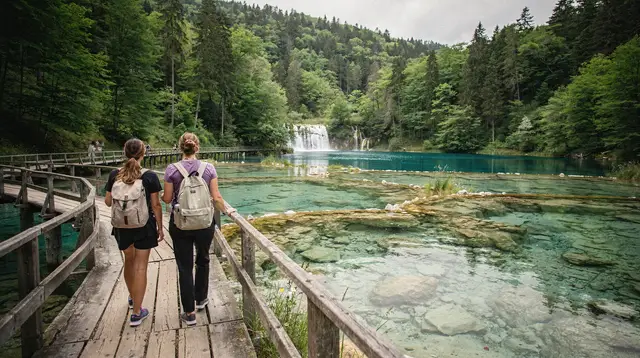
Once I was actually walking the boardwalks, the crowd noise (literal and figurative) faded faster than I expected. Plitvice is built around 16 terraced lakes connected by waterfalls, and the water is the kind of turquoise-green that looks fake in photos until you’re standing over it. Wooden boardwalks thread directly across and beside the water, close enough that spray from the smaller falls reaches you on a windy day. The famous panoramic viewpoint over the Lower Lakes — the one you’ve seen a hundred times on Instagram — is worth the buildup, crowd or no crowd.
What surprised me most was how quickly the scenery earns its reputation. I’d read plenty about Plitvice before going, and I still wasn’t prepared for how layered it is: lakes above lakes, waterfalls feeding waterfalls, forest closing in right up to the boardwalk edge. Even shuffling along in a slow-moving line of people, I kept stopping to take the same photo three different tourists had just taken.
The one rule that isn’t up for debate
Swimming is not permitted anywhere in Plitvice Lakes National Park — not at the edges, not in the quieter upper lakes, not if it’s 35°C and the water looks impossibly inviting after an hour of walking in the sun. This isn’t a soft suggestion or a rule that loosens in the off-season; it’s a permanent, park-wide ban, enforced by rangers who are used to explaining it to disappointed visitors. I’d guess this is the single most common mistake first-time visitors make, simply because the water looks so clear and so cool. Bring a swimsuit for somewhere else. Not here.
Weighing it honestly: pros and cons of an August visit
| Factor | August reality |
|---|---|
| Scenery | Full summer green, waterfalls at good flow, genuinely stunning |
| Crowds | Heaviest of the year; boardwalk bottlenecks, especially midday |
| Tickets | Must be booked online with a timed entry slot |
| Heat | Can be intense on exposed sections; boardwalks offer little shade |
| Photos without people | Very hard except very early or very late in your visit window |
| Water access | Zero — swimming banned throughout, no exceptions |
| Transport from Zadar | About 2 hours each way, doable as a long day trip |
If I’m being fully honest, the crowds are the real cost of an August visit — not the heat, not the ticket hassle, but the simple fact that you’ll be sharing narrow boardwalks with a lot of other people, and the classic viewpoints will have other tourists in your photos unless you’re patient or lucky. What you get in exchange is long daylight hours, full green forest, and waterfalls running at a level that thinner autumn rain can’t always match.
Combining Plitvice with the rest of the trip
If you’re not just doing Plitvice as a one-off, it’s worth thinking about where it fits in a longer Croatia trip. Some visitors pair it with the watermill village of Rastoke, which sits close enough to Plitvice that a Plitvice and Rastoke combo tour makes sense as a single day out rather than two separate trips. Others prefer to go early and beat the coach groups with a Plitvice early access tour, which gets you inside before the bulk of the day-trippers arrive — genuinely useful advice for August specifically, since the first hour after opening is the closest you’ll get to empty boardwalks.
If you’d rather explore at your own pace instead of a fixed group itinerary, a private tour of Plitvice from Zadar lets you set the route and the stops yourself, and a small-group tour is a middle ground if you want a guide without a full coach-sized crowd. For anyone weighing whether a guide is worth it at all versus just walking the boardwalks solo, I’d say August is exactly the season where a guided walking tour earns its cost — someone who knows the layout can route you around the worst bottlenecks in real time.
Plitvice isn’t the only national park within reach of Zadar, either. If you’re building a longer itinerary, a three-day Zadar, Krka and Plitvice route covers both of the region’s big national parks without feeling rushed, and a five-day national parks itinerary goes further and folds in more of the Velebit and Zrmanja side of the region too. And if August crowds specifically are what’s giving you pause, it’s worth reading about overtourism in North Dalmatia and when to go before you commit to dates — it covers the same trade-off from a wider angle than just this one park.
So — worth it, or not?
I’d go back in August. I’d also, if I had the choice again, seriously consider shoulder season instead — May-June or September-October tend to bring thinner crowds while the park still looks green and the falls still run well. But I wouldn’t tell anyone to skip an August visit outright. The lakes don’t stop being one of the most striking landscapes in Croatia just because more people know it. You just need to go in with a plan: book timed tickets ahead of time, start early, pick your entrance deliberately, and accept that you’re seeing this place the way most of the world sees it — in season, in numbers, and still worth every bit of the two-hour drive from Zadar.
For a different kind of comparison, I’ve also written about Krka versus Plitvice if you’re trying to choose between the two national parks on a single trip, and about how many days to spend in Zadar if Plitvice is just one piece of a longer itinerary. If you’d rather not drive yourself and deal with parking in peak season, a guided tour of Plitvice or a more in-depth small-group tour of the national park both handle the ticket and timing logistics for you.
Plitvice in August: your questions answered
Is Plitvice too crowded to enjoy in August?
It’s genuinely crowded, especially between mid-morning and mid-afternoon, but the park is large enough and the scenery striking enough that most visitors still come away impressed. Early entry and a timed ticket help enormously.
Do I need to book tickets in advance for Plitvice in summer?
Yes. In August, walk-up tickets are unreliable and often unavailable. Book a timed entry ticket online in advance, or book a guided day trip that includes the ticket.
What’s the difference between Entrance 1 and Entrance 2 at Plitvice?
Entrance 1 is closer to the Lower Lakes and the well-known panoramic viewpoint; Entrance 2 is closer to the Upper Lakes. Both get busy in August, but starting at whichever entrance matches your planned route helps you avoid backtracking through the thickest crowds.
How long does it take to get to Plitvice from Zadar?
The drive is roughly 120–130 km and takes about two hours each way, making it a feasible (if long) day trip from Zadar.
Can you swim at Plitvice Lakes?
No. Swimming is banned throughout the entire national park, with no seasonal exceptions, regardless of how warm or inviting the water looks in August.
Is Plitvice better in shoulder season than in August?
Shoulder season (May-June or September-October) generally means thinner crowds and shorter queues, while the park still looks green and the waterfalls still run well. August offers longer days and full summer scenery, at the cost of the heaviest crowds of the year.
Is Plitvice suitable for a day trip, or should I stay overnight nearby?
Most visitors coming from Zadar manage it comfortably as a long day trip. If you want a slower pace or plan to combine it with nearby Rastoke, staying a night closer to the park is worth considering.
Are the boardwalks at Plitvice accessible for all fitness levels?
The boardwalks are mostly flat and well-maintained, though some sections involve stairs and can get congested in peak season, which slows overall walking pace regardless of fitness level.
Tour Comparisons
Verified deep-linked GetYourGuide tours. Book through these links and we earn a small commission at no cost to you.
GetYourGuide does not provide a product photo for this activity — the image shows the meeting point, photographed by us.