Plitvice Lakes Guided Walking Tour: Boardwalks Through 16 Terraced Lakes
What does a guided walking tour of Plitvice Lakes actually cover?
A guided walking tour follows the park's wooden boardwalks and footpaths around the 16 terraced lakes and their connecting waterfalls, usually combined with a short boat crossing on the largest lake, Kozjak. A ranger-trained or licensed local guide explains the geology, the lakes' travertine formation and the strict no-swimming rule, while handling orientation between the numbered entrances and trails so you don't have to plan the route yourself.
Walking the Boardwalks at Plitvice Lakes
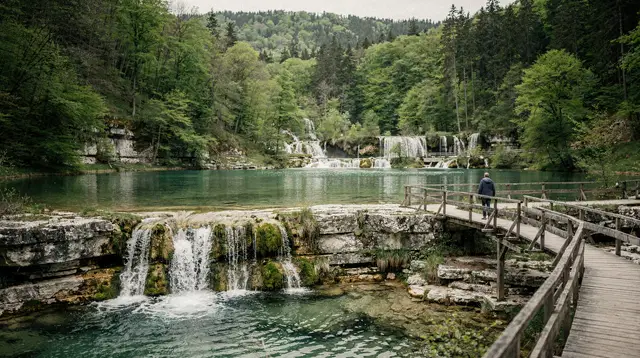
Plitvice Lakes National Park is built for walking. There is no single viewpoint that captures it, and no road that runs through the middle of it — the only way to actually see the 16 terraced lakes and the waterfalls that connect them is on foot, on a network of wooden boardwalks and footpaths that thread along the water’s edge, sometimes directly over it. A guided walking tour takes that network and turns it into a route: someone who knows which boardwalk sections get crowded by midday, where the boat crossing on Kozjak lake fits into the loop, and how to read the terrain so you’re not backtracking through the same stretch twice.
This guide covers what a guided walking tour at Plitvice actually involves, why the boardwalks exist the way they do, the UNESCO listing behind the park’s protected status, and the one rule every visitor needs to know before they arrive: nobody swims here, ever.
Why the Boardwalks Exist
The lakes at Plitvice aren’t static. They’re formed and constantly reshaped by travertine (also called tufa) — a soft limestone deposit built up by moss, algae and bacteria that gradually cements plant material, forming natural dams between one lake and the next. Water spills over these barriers as waterfalls, and the barriers themselves keep shifting, which is part of why the park looks the way it does and why the terrain right at the water’s edge is fragile.
The wooden boardwalks solve two problems at once. They let visitors get close to the water — often just centimetres above it, with fish visible underneath and spray from smaller waterfalls reaching the rail — without visitors’ feet ever touching the travertine formations that are still actively building. And they concentrate foot traffic onto a fixed path, which is the only way a park that receives heavy seasonal visitor numbers can avoid eroding the very feature people come to see.
On a guided walking tour, this matters practically: guides know which boardwalk sections are one-way only during peak hours, where passing space is tight, and how to keep a group moving without blocking narrower stretches for everyone else.
The 16 Lakes, Roughly
The park’s lakes are conventionally split into an Upper and a Lower group, cascading down through forested terrain before the Lower lakes end in a canyon near Sastavci, close to the Lower Entrance (Entrance 1). The Upper lakes tend to be gentler, wooded and more spread out; the Lower lakes are more dramatic, with the tallest waterfalls and more open limestone canyon walls. A guided walking tour typically links sections of both, with the exact combination depending on the specific itinerary, the season, and how much of the walk is on foot versus by the park’s electric boat across Kozjak lake or its internal shuttle bus.
Because trail combinations, distances and boat crossing points can change between seasons and even between tour operators, this guide won’t state an exact route length in kilometres or a fixed walking time — check the specific tour listing you’re considering for its stated distance and duration before booking.
For a side-by-side comparison with Krka, the other major waterfall park in the region, see Krka vs Plitvice: which to choose.
The No-Swimming Rule
This is the single most important practical fact about visiting Plitvice: swimming is prohibited throughout the park, at every lake, every waterfall pool, and every stretch of connecting water. It is not seasonal, it is not limited to the more dramatic waterfalls, and it is enforced. On a hot day the water can look extraordinarily inviting — clear, turquoise-green, still in the upper lakes — but wading in, even briefly for a photo, is against the rules that protect the fragile travertine formations underfoot.
This is a genuinely common point of confusion for first-time visitors, partly because swimming is allowed (and popular) at some other freshwater sites in Croatia, and partly because the water simply looks swimmable. A guided walking tour is a useful way to have this rule reinforced clearly and early, rather than finding out from a park ranger mid-visit. If you’re weighing Plitvice against Krka National Park, it’s worth knowing the same rule applies there too — Krka’s main waterfall, Skradinski buk, has banned swimming since 2021, so this isn’t a Plitvice-only restriction. For more on that, see Krka after the swimming ban.
A UNESCO Site Since 1979
Plitvice Lakes National Park was inscribed as a UNESCO World Heritage Site in 1979, making it one of the earliest natural sites anywhere to receive the designation — well before Croatia’s other natural and cultural UNESCO listings, including the Venetian defensive walls that later took in parts of Zadar and Šibenik. The listing recognises the lakes’ ongoing travertine formation process as an active geological phenomenon, not just a scenic result, which is part of why the park’s management is so protective of the boardwalk network and so strict about staying on marked paths.
That UNESCO status also explains the scale of visitor management at the park: numbered entrances, timed ticketing in peak months, and a boardwalk system engineered specifically to route large numbers of people without letting them touch the terrain that’s still forming. A guided walking tour operates inside that same system — it doesn’t bypass ticketing or entrance logistics, but it does remove the guesswork of navigating them.
What a Guided Walking Tour Includes
Specifics vary by operator and itinerary, but a typical guided walking tour at Plitvice follows a broadly similar shape:
| Element | What it usually means |
|---|---|
| Transport | Round-trip transport from Zadar or a meeting point near the park, on tours that include it |
| Park entry | Ticket included or reserved in advance, avoiding on-the-day queues |
| Guide | A licensed guide walking with the group, explaining geology, formation and park rules |
| Boardwalk route | A set loop through Upper and/or Lower lakes, adapted to group pace and season |
| Boat crossing | A short electric-boat ride across Kozjak lake, included on most itineraries |
| Free time | Some tours build in independent time to walk at your own pace before regrouping |
For a day trip from Zadar specifically, including the roughly two-hour road journey each way, see Plitvice Lakes day trip from Zadar. If you’d rather explore at your own pace once inside the park, Plitvice Lakes private tour from Zadar covers that option, and Plitvice Lakes early access tour covers entering ahead of the main crowds.
One well-reviewed option combines the boardwalk route with a boat ride across Kozjak lake as part of the same guided route:
a guided walking tour of the lakes with a boat crossing includedA closely related version follows the same idea with a slightly different combination of walking and boat time:
a guided walking route paired with a lake boat rideFor visitors coming without their own transport, there’s also an option that folds in the road journey itself:
a guided tour that combines coach transport with the boardwalk walk and boat rideAnd for anyone worried about entry logistics in peak season, one itinerary bundles the walking route with a reserved ticket slot:
a guided walking tour with your park ticket reserved in advanceChoosing Between Entrances and Trail Styles
Plitvice has two main entrances — commonly referred to as Entrance 1 (near the Lower lakes and closer to the dramatic waterfalls at Sastavci) and Entrance 2 (near the Upper lakes and Kozjak lake, the boat crossing point). Independent visitors have to choose which entrance to start from and how to route themselves between the two lake groups using the park’s internal shuttle buses and the Kozjak boat. On a guided walking tour, that decision is made for you as part of the fixed itinerary, which is one of the main practical advantages over a self-guided visit — see Plitvice Lakes tour tips: what to know for more on how the two entrances differ.
If your priority is avoiding crowds on the boardwalks, an early-morning start matters more than which entrance you use — the busiest midday hours, especially in July and August, can mean genuine bottlenecks on the narrower boardwalk sections near the main waterfalls.
Rastoke: A Short Add-On, Not Part of the Park
North of Plitvice, in the town of Slunj, sits Rastoke — a small cluster of old watermills built where the Slunjčica and Korana rivers meet, with cascades running directly beneath and around the wooden houses. It’s a genuinely different site from Plitvice itself, smaller in scale and without an entrance fee structure resembling the national park’s, but it pairs naturally with a Plitvice day out because it sits close to the route back toward the coast.
Several combined itineraries add it as a short stop after the main park visit; see Plitvice Lakes and Rastoke combo tour and Rastoke watermill village day trip for more detail on what that stop involves.
Plitvice or Krka: A Quick Comparison
Visitors planning a single national-park day from Zadar often have to choose between Plitvice and Krka, since both are popular but sit in different directions and have distinct characters.
| Plitvice Lakes | Krka National Park | |
|---|---|---|
| Distance from Zadar | Roughly 120–130 km, about 2 hours | Roughly 85–90 km |
| Main feature | 16 terraced lakes linked by waterfalls | Skradinski buk waterfall, reached by boat from Skradin |
| Swimming | Prohibited throughout | Prohibited at Skradinski buk since 2021 |
| UNESCO status | Inscribed 1979 | Not a UNESCO site |
| Typical visit style | Boardwalk walking loop, boat across Kozjak | Boat ride to the falls, shorter walking circuit |
Both are boardwalk- and footpath-based, both ban swimming at their main features, and both reward an early start. If you’re undecided, Krka vs Plitvice: which to choose goes into more detail on which suits different kinds of travellers.
Practical Notes Before You Go
Footwear matters more at Plitvice than at most stops in North Dalmatia — boardwalks can be slick with spray near waterfalls, and some connecting sections involve natural stone steps rather than flat wood. Comfortable closed shoes with grip are worth prioritising over sandals, even in summer heat.
Weather also shifts the experience considerably: the park is open year-round, but winter can bring ice on the boardwalks (sometimes requiring specific winter trail closures) while summer brings both the fullest waterfalls after spring rain and the heaviest crowds. Neither entrance fees nor exact seasonal opening times are listed here, since both change; check the live tour or ticket listing for current details rather than an estimate.
Bring a light rain layer regardless of season — waterfall spray reaches several of the closer boardwalk sections, and it’s a common surprise for visitors expecting a fully dry walk.
Getting There from Zadar
Most guided walking tours depart from Zadar itself, covering the roughly 120–130 km, two-hour road journey as part of the package. If you’d rather compare the drive itself against other day-trip options from Zadar, day trips from Zadar: best options lays out how Plitvice stacks up against Krka, Nin, Pag and the islands in terms of travel time.
For visitors weighing a multi-day national park itinerary rather than a single day trip, five days: national parks Zadar combines Plitvice with Krka and the Velebit–Zrmanja country over a longer stay, and one day Plitvice from Zadar sketches a single-day-focused plan.
Plitvice Lakes Guided Walking Tour: Frequently Asked Questions
Can you swim in Plitvice Lakes?
No. Swimming is prohibited throughout Plitvice Lakes National Park, and this is strictly enforced. The lakes and waterfalls are for viewing from the boardwalks and trails only, not for bathing, wading or paddling.
Why is Plitvice Lakes a UNESCO World Heritage Site?
Plitvice Lakes National Park was inscribed on the UNESCO World Heritage list in 1979, one of the earliest natural sites anywhere to receive the designation, recognised for its 16 terraced lakes linked by waterfalls and the ongoing travertine (tufa) formation that continues to reshape the barriers between them.
Do I need to book Plitvice tickets in advance?
In peak season the park uses timed entry, and tickets can sell out on busy summer days, so advance booking is strongly recommended. For current entrance fees, ticket windows and time-slot availability, check a live tour or ticket listing rather than relying on a fixed figure, since these details change by season.
How long does a guided walking tour of Plitvice take?
Tour lengths vary by itinerary and by how much of the boardwalk network and boat crossing is included, so exact durations are best confirmed on the specific tour listing you book rather than assumed in advance.
Are the boardwalks at Plitvice suitable for children or less mobile visitors?
The boardwalks are flat, wooden and railed, which makes them manageable for most families and moderately mobile visitors, though some stretches involve stairs, uneven natural terrain, or crowding in peak season. A guided tour helps by choosing a route suited to the group and keeping pace steady.
What is the difference between a guided walking tour and visiting Plitvice independently?
An independent visit means self-navigating the numbered entrances, trail letters and boat and shuttle stops, and researching the geology on your own. A guided walking tour handles the route and logistics and adds a local guide’s explanation of how the lakes and waterfalls formed and why the park enforces its rules, at the cost of a fixed schedule and group pace.
Is Plitvice Lakes worth visiting as a day trip from Zadar?
Plitvice is a popular day trip from Zadar thanks to the road distance of roughly 120–130 km, about two hours each way. A guided day tour typically bundles transport, park entry and a walking route, which removes the need to arrange driving, parking and ticket logistics separately.
Can you combine Plitvice Lakes with Rastoke on the same day?
Yes. Rastoke, a watermill village in Slunj, sits north of the Plitvice park and is commonly paired with it as a short additional stop on combined tours, since it is a separate site from the lakes themselves and only takes a modest amount of extra time.
Plitvice Lakes Tours
Verified deep-linked GetYourGuide tours. Book through these links and we earn a small commission at no cost to you.
GetYourGuide does not provide a product photo for this activity — the image shows the meeting point, photographed by us.