Plitvice Lakes and Rastoke Combo Tour
What does a Plitvice Lakes and Rastoke combo tour actually include?
It pairs a guided walk through Plitvice Lakes National Park with a stop in Rastoke, a small watermill village at Slunj just north of the park. Plitvice is the main event and takes up most of the day; Rastoke is usually a shorter add-on stop on the way back toward Zadar.
Two landscapes, one day out from Zadar
Most day trips from Zadar that mention “Plitvice” are really about a single destination: Plitvice Lakes National Park, the terraced lake system that has drawn visitors to inland Croatia for decades. A combo tour adds a second, much smaller stop — Rastoke, a watermill village built where the Slunjčica river meets the Korana, a short distance north of the park near the town of Slunj. The two places share a family resemblance — water, waterfalls, old stone and wood structures — but they are not the same site, and a combo itinerary treats them as two separate stops rather than one continuous park.
This guide explains what each half of the day actually involves, what the swimming ban at Plitvice means in practice, why the park carries UNESCO status, and how to think about booking a combo tour versus visiting Plitvice on its own.
Plitvice Lakes National Park: the main event
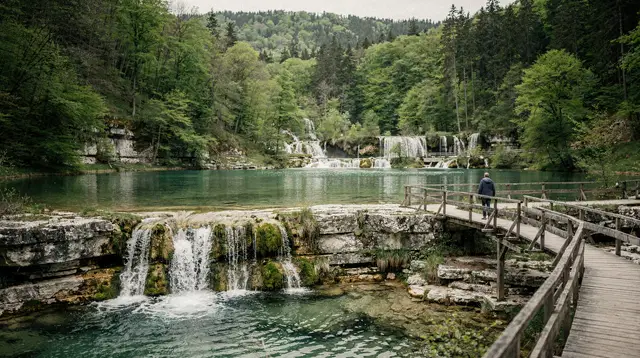
Plitvice Lakes National Park has been a UNESCO World Heritage Site since 1979, one of the earliest natural sites in Europe to receive the designation. The park protects sixteen terraced lakes, connected by a chain of waterfalls and linked by wooden boardwalks that wind along the water’s edge, through beech and fir forest, and across the travertine barriers that separate one lake from the next. The lakes range in color from turquoise to deep green and grey-blue, a shifting effect caused by minerals, algae and the angle of light rather than any single fixed color.
The park has two main entrances, generally referred to as Entrance 1 and Entrance 2, and most guided routes combine walking on the boardwalks with a stretch on the park’s electric boat across the largest lake, Kozjak, and sometimes a panoramic shuttle between sections of the park. A guided tour typically follows one of several marked routes that loop through the Lower Lakes, the Upper Lakes, or both, depending on the operator and the time available.
The swimming ban, stated plainly
Swimming is not permitted anywhere in Plitvice Lakes National Park — not in the lakes, not at the base of any waterfall, in any season. This is a standing park rule, not a seasonal restriction that relaxes in summer heat. It exists to protect the travertine formations and the water quality that the whole park depends on, and it is enforced.
If you are visiting in July or August and the water looks inviting after a long walk, it’s worth knowing in advance that this is one stop where getting in the water simply isn’t an option, at Plitvice or at Krka National Park either, where the same ban has applied at the main waterfall since 2021. For a direct comparison of the two parks and how their rules and routes differ, see Krka vs Plitvice: which to choose.
Booking tickets and choosing a route
Because Plitvice is one of the most visited national parks in Croatia, entry in peak season runs on timed tickets, and popular time slots can sell out, particularly in July and August. A guided combo tour usually handles ticket logistics as part of the booking, which removes one layer of planning from a day that already involves transport, timing and navigating multiple boardwalk sections. For a broader rundown of what to expect and how to prepare, see Plitvice Lakes tour tips: what to know.
Several guided formats run from Zadar and the surrounding region, each covering slightly different ground. A standard guided walking tour of Plitvice Lakes covers the park’s core boardwalk sections with a licensed guide, while a guided tour taking in both the Lower and Upper Lakes goes further into the park’s less-crowded upper section.
Travelers who prefer their own pace can look at a private guided tour of Plitvice, and those short on time can opt for a half-day tour around Plitvice Lakes that trims the itinerary to the park’s highlights. A version that folds in the park’s electric boat crossing is worth considering too — see the guided tour of Plitvice with a boat ride included for that combination.
Check each tour listing directly for exact duration, which entrance it uses, and whether Rastoke or any other stop is included — combo formats vary by operator, and this page does not fix a single combined price or a precise distance between the two stops.
Rastoke: the watermill village at Slunj
North of Plitvice, at the town of Slunj, the Slunjčica river breaks into a series of small waterfalls and channels as it flows into the Korana. Around these falls sits Rastoke, a cluster of old wooden watermills and houses built directly over and beside the water, some of them centuries old. It is a compact village — walkable in far less time than a full Plitvice circuit — and its appeal is different in kind from the national park: smaller in scale, closer to a historic working settlement than a wilderness landscape, with mill wheels, footbridges and wooden buildings set right against the falling water.
Rastoke is not part of Plitvice Lakes National Park. It sits outside the park boundary, and it is administered and visited as its own site. On a combo tour, it typically functions as a shorter stop bolted onto a Plitvice-centered day, often on the return leg toward Zadar, since Slunj lies broadly on the route back from the park. This guide does not state a fixed distance between the two, since that detail depends on the specific route an operator uses — check the tour listing you’re booking for its exact itinerary and timing.
How a combined day typically unfolds
A Plitvice and Rastoke combo day generally follows a similar shape across operators, even though exact timings differ:
| Segment | What happens |
|---|---|
| Departure from Zadar | Early morning pickup or meeting point, transfer inland |
| Plitvice Lakes National Park | The main block of the day — guided boardwalk walking, often with a boat crossing on Kozjak lake |
| Rastoke, Slunj | A shorter stop to see the watermills and waterfalls of the village |
| Return to Zadar | Afternoon or evening transfer back to the coast |
Because Plitvice takes up the bulk of the schedule, Rastoke is best approached as a bonus rather than the reason to book — a chance to see a very different kind of water-powered landscape on the same trip, without needing a separate excursion. Travelers who want to weigh Rastoke against other Plitvice add-ons, or who are deciding how much time to give the region overall, may find it useful to read how many days to spend in Zadar and day trips from Zadar: best options before choosing a specific itinerary.
Alternatives if you want more time in one place
Not every visitor wants Plitvice and Rastoke squeezed into the same day. A few adjustments are worth considering depending on your priorities:
- More time inside Plitvice itself: choose a tour focused purely on the park’s Upper and Lower Lakes rather than one that budgets time for a second stop.
- A private pace: a private Plitvice tour lets you set your own rhythm through the boardwalks, which matters if you want to linger at specific viewpoints or waterfalls.
- A shorter day overall: the half-day Plitvice option suits travelers combining the park with other plans on the same day, or those who simply don’t want a full twelve-hour excursion.
- Skip the boat, add walking distance: some Lower and Upper Lakes itineraries prioritize boardwalk coverage over the boat crossing — worth checking against the boat-inclusive option if the electric boat ride across Kozjak matters to you.
For travelers weighing Plitvice against the other major national park in the region, Krka vs Plitvice: which to choose lays out the practical differences — including the fact that both parks share the same no-swimming rule, even though Krka’s ban is a more recent change (2021) than Plitvice’s, which has applied throughout the park’s history as a protected site.
Practical notes before you go
- Footwear: the boardwalks near waterfalls carry spray and can be slippery even on dry days — shoes with real grip matter more than fashion here.
- Weather layers: temperatures near the water and under forest cover run noticeably cooler than the surrounding open ground, even in summer.
- Camera batteries: between the terraced lakes, waterfalls and the mill wheels at Rastoke, this is a photograph-heavy day — bring spare battery or storage if you shoot a lot.
- No swimming, anywhere in the park: worth repeating, since it’s the single most common point of confusion for first-time visitors to Plitvice.
- Confirm what’s included: since combo formats vary, check each tour listing for whether Rastoke is guided or a self-guided stop, how much time is allotted to each site, and what the return time to Zadar looks like.
Getting from Zadar to Plitvice
Zadar sits closer to Plitvice than either Split or Zagreb, which is one reason so many combo tours run from here rather than from the bigger coastal cities. Most guided combo tours include transport as part of the package, picking up from a central meeting point in Zadar and driving inland on the route toward Lika. Travelers who would rather handle the trip independently, without a guide, can also look at the bus from Zadar to Plitvice and Krka, which covers public transport timings and where the bus drops you relative to the park entrances.
If you’re deciding between a self-drive day and a rental car more generally for exploring inland from the coast, the car rental in Zadar guide is a useful starting point, though a guided combo tour remains the simpler option for a single day that also needs timed park tickets sorted out in advance.
Where Plitvice and Rastoke fit into a longer Zadar trip
A single combo day covers a lot of ground, but it’s only one way to see the Lika region from a Zadar base. Travelers building a longer itinerary sometimes prefer to treat Plitvice as its own dedicated day rather than pairing it with Rastoke — see Plitvice Lakes day trip from Zadar for that more focused version, or the Plitvice Lakes small group tour and Plitvice Lakes private tour from Zadar for other formats that don’t include Rastoke as a stop.
Early risers who want to beat the peak-season crowds at the park entrances might also look at the Plitvice Lakes early access tour, which front-loads the day before the boardwalks fill up.
For travelers with more than one day to give the inland national parks, it’s worth reading how Plitvice compares with the other major karst park in the region covered on this site, Krka National Park — a shorter drive from Zadar than Plitvice, with its own waterfalls and a different, more coastal character. A Krka National Park day trip from Zadar or a Krka waterfalls and Šibenik combo tour both make sense as a second inland excursion on a longer stay, and neither requires backtracking through the same route as the Plitvice day.
Those planning several days around Zadar rather than a single excursion may also want the wider view in three days Zadar, Krka, Plitvice or five days national parks Zadar, both of which sequence the region’s inland parks against the coastal sights without cramming everything into one long day.
If Rastoke’s mix of water, old mills and wooden footbridges appeals to you as a subject in its own right rather than a quick add-on stop, the dedicated Rastoke watermill village day trip piece goes into more detail on the village itself, separate from how it fits into a Plitvice-centered itinerary.
Plitvice and Rastoke versus a coastal day
It’s worth being honest about what a Plitvice and Rastoke day is not: it is not a beach day, a boat day, or a day spent among the islands that make up most of the rest of this site’s coverage. The Zadar region’s identity runs heavily coastal — the Zadar Archipelago, Kornati National Park, and the islands around Ugljan and Dugi Otok — and a trip inland to Plitvice and Rastoke is a deliberate change of scenery for a day, swapping salt water and limestone islands for freshwater lakes, forest and travertine.
Some travelers split a longer stay evenly between the two; others treat the national parks as a single inland day bookending a week that’s otherwise spent on the water. Either approach works, and how many days to spend in Zadar covers how to balance inland excursions like this one against the coastal itinerary most first-time visitors come for.
Frequently asked questions about the Plitvice and Rastoke combo tour
Can you swim at Plitvice Lakes?
No. Swimming is banned throughout Plitvice Lakes National Park, in every lake and at every waterfall, regardless of the season or how warm the water looks.
Is Rastoke part of Plitvice Lakes National Park?
No. Rastoke is a separate watermill village at Slunj, north of the park boundary. It is a distinct stop, usually visited on the way to or from Plitvice, not an area inside the national park itself.
Why is Plitvice a UNESCO World Heritage Site?
Plitvice Lakes National Park was inscribed on the UNESCO World Heritage list in 1979, recognized for its sixteen terraced lakes linked by waterfalls and its exceptional travertine and karst landscape.
How far is Rastoke from Plitvice Lakes?
Rastoke sits north of the park near Slunj. An exact distance isn’t fixed here — check the specific tour listing for the route and timing it uses, since combo tours can differ in how they link the two stops.
Do I need to book Plitvice tickets in advance?
In peak season, yes — Plitvice uses timed entry tickets that can sell out, so booking ahead is strongly recommended. Check the live tour listing for what is included and how entry is handled.
How long does a Plitvice and Rastoke combo day take?
It’s a full-day trip from Zadar, with the bulk of the time spent walking the boardwalks and boat/shuttle sections inside Plitvice, and a shorter stop at Rastoke. Exact durations vary by operator — check the tour listing for specifics.
Is Plitvice suitable for people with limited mobility?
Parts of the boardwalk network are accessible, but the terrain includes wooden walkways, some slopes and stairs, and long walking distances. Check accessibility details directly with the tour operator before booking.
What should I bring on a Plitvice and Rastoke day trip?
Comfortable walking shoes with grip (the boardwalks can be slippery from spray), a layer for cooler air near the water, and a water bottle. Cameras are welcome; swimwear is not useful here.
Plitvice Lakes Tours
Verified deep-linked GetYourGuide tours. Book through these links and we earn a small commission at no cost to you.
GetYourGuide does not provide a product photo for this activity — the image shows the meeting point, photographed by us.