How Many Days to Spend in Zadar
How many days should you spend in Zadar?
Two full days cover the Old Town at a relaxed pace. Add a third day for Plitvice Lakes (about 2 hours each way) or Krka National Park (roughly 85-90 km away), and a fourth for a boat trip into the Zadar archipelago. Four to five days lets you do all of it without rushing between buses and boats.
The Honest Answer First
There is no single correct number of days for Zadar. The right length depends on what you actually want to see beyond the Old Town itself, and Zadar’s real appeal is less about the city alone than about what surrounds it: two major national parks within a couple of hours, an archipelago of islands reachable only by boat, and a coastline that stretches from the salt pans of Nin to the stone streets of Sibenik. Treat any blog post that gives you a flat “spend 3 days in Zadar” as a starting point, not a rule, and build your own number from the pieces below.
The honest way to plan is to treat Zadar as a base with layers. Layer one is the Old Town peninsula itself, which is small and walkable. Layer two is the two big inland national parks, Plitvice Lakes and Krka National Park, each of which is its own day. Layer three is the sea: the nearby islands and the more remote Kornati National Park, which need a boat and a full day to do properly. Add up only the layers you actually want.
Layer One: The Old Town Needs Two Days, Not One
If you do nothing but walk Zadar’s peninsula, two days is the sensible minimum, and one day is workable only if you accept a fast pace. The Old Town is compact — you can cross it on foot in twenty minutes — but its landmarks reward slowing down rather than rushing past.
On a first day, most visitors walk from the Land Gate through the old streets to the Roman Forum, pause at the round, pre-Romanesque St Donatus Church beside it, then continue to the Cathedral of St Anastasia, whose bell tower can be climbed for a view over the rooftops. Five Wells Square sits nearby as a quieter stop. All of this can be covered at an easy walking pace in half a day, leaving the afternoon or evening free.
The second day, or the second half of the first, belongs on the Riva, where the Sea Organ and the Greeting to the Sun stand together at the tip of the peninsula. The Sea Organ is meant to be heard, not just seen — its sound comes from waves moving through pipes under the marble steps, never from wind or electricity — and it is worth returning to at different times of day, since the sea state changes the sound.
The Greeting to the Sun charges from daylight and lights up after dark, so the obvious plan is to watch the sunset here and stay through the first hour of night. Zadar’s sunset has a semi-famous reputation, tied to a story that Alfred Hitchcock once called it the most beautiful in the world — treat that as a nice piece of local lore rather than a documented quote, since no reliable source pins it down.
A gentle way to cover the peninsula without planning your own route is a guided walking tour of the Old Town, and for the evening specifically there is a dedicated Sea Organ sunset walking tour timed around golden hour. If food matters to your trip, a food walking tour is a reasonable way to fold eating into your sightseeing rather than treating it as a separate errand — and it is worth trying a taste of Maraska maraschino cherry liqueur, a genuine local specialty, while you are at it.
Two days at this pace is enough to see everything the Old Town holds without feeling rushed, plus a slower evening on the Riva. One day is possible if your trip is short, but expect to move briskly and skip either the bell tower climb or a proper sit-down dinner.
Layer Two: Add a Day for Plitvice, and a Separate Day for Krka
This is where trip length usually grows, and for good reason: Plitvice Lakes and Krka are two different national parks, roughly two hours apart from Zadar in different directions, and each deserves its own day rather than a shared, rushed itinerary.
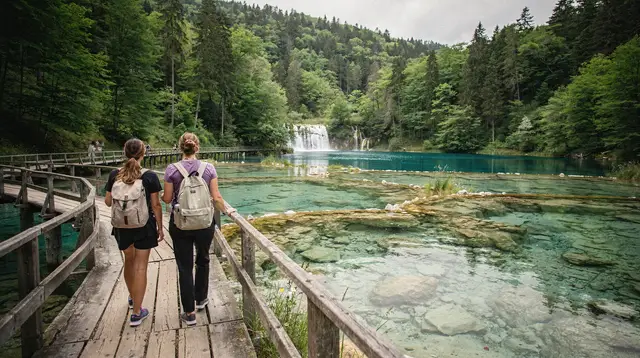
Plitvice Lakes National Park is roughly 120-130 km from Zadar, about two hours by road. It has been a UNESCO World Heritage Site since 1979, and its sixteen terraced lakes, linked by waterfalls, are Croatia’s best-known natural attraction. Swimming is banned throughout the park — this trips up more visitors than almost anything else here, so build the expectation of walking boardwalks and taking photos, not wading in, into your plan. In summer, tickets are timed and often need to be booked in advance, and the park has two main entrances, so it helps to know which one your route uses before you arrive.
A day trip to Plitvice from Zadar or a guided walking tour of Plitvice Lakes both handle the transfer and the walking route for you, which is worth considering given the round-trip driving time. If you want to add texture to the day, the nearby watermill village of Rastoke sits north of the park and pairs well as a short extra stop, and a Plitvice and Rastoke combo tour covers both in one outing.
Krka National Park is roughly 85-90 km from Zadar, closer than Plitvice but still a genuine day trip rather than a quick errand. Its centerpiece, the Skradinski buk waterfall, is reached by boat from the town of Skradin, and further stops inside the park include Roški slap and the island monastery of Visovac. As with Plitvice, there is one rule worth knowing before you go: swimming at Skradinski buk has been banned since 2021, and this is a standing rule, not a seasonal one, so do not plan the day around a swim. A Krka day trip from Zadar or a boat tour that departs from Skradin covers the park’s main sights without you needing to work out the boat schedule yourself.
Since Krka sits closer to Sibenik than Zadar’s Old Town does, some visitors combine the two: a Krka and Šibenik combo tour is one way to see Šibenik’s Cathedral of St James and Krka’s waterfalls in a single day, and a separate tour of St Nicholas Fortress and Tijat Island near Šibenik is worth a look if the town’s Venetian defenses interest you more than the waterfalls.
The trap to avoid is trying to combine Plitvice and Krka into one long day. They sit in different directions from Zadar, and stacking two hours-plus of driving each way onto one day leaves very little time to actually walk either park. If both parks matter to your trip, the more comfortable plan is two separate days — see the comparison in Krka vs Plitvice: which to choose if you are trying to pick just one instead.
| Add to your trip | Distance from Zadar | Realistic time needed |
|---|---|---|
| Old Town only | — | 1-2 days |
| Plitvice Lakes | ~120-130 km, ~2 hours | 1 full day |
| Krka National Park | ~85-90 km | 1 full day |
| Nearby archipelago (Ugljan, short boat trip) | offshore, short crossing | half day to 1 day |
| Kornati / Telašćica | offshore, boat-only | 1 full day |
Layer Three: The Archipelago Needs Its Own Day, Because It’s Boat-Only
The Zadar archipelago is a different kind of day trip, because it can only be reached by water. There is no road option here, which makes it easier to plan around: you are either booking a boat, or you are not going.
The closest and easiest option is a short hop to Ugljan, known for its olive groves and the small town of Preko, which sits opposite the tiny islet of Ošljak. A boat tour to Ugljan and Preko or a private boat trip to Ugljan Island can realistically fit into half a day, which makes it a reasonable add-on even on a shorter trip.
Further out, Kornati National Park and Telašćica Nature Park on the southeastern tip of Dugi Otok are a different scale of trip. Kornati protects roughly 89 islands, islets and reefs within the park boundary — the wider Kornati archipelago runs to about 140 — and it is almost entirely bare limestone, with no roads or bridges connecting it to anywhere. It is reached by boat from Zadar, Biograd, Murter or Sali, and because the crossing itself takes real time, these are sold as full-day trips.
A Kornati boat tour from Zadar or a combined Kornati and Telašćica tour are the two common ways to cover this ground, and Telašćica’s salt lake and sea cliffs rising to roughly 160 m are worth the added stop if your tour includes it. Dugi Otok’s Sakarun beach, a shallow bay of white pebbles, is a separate stop again, covered by a Sakarun beach day trip.
If you would rather stay closer to the city and skip the outer islands, a simple boat tour around Zadar’s coastline or an on-the-water view of the Sea Organ gives you a different angle on the Old Town without committing a full day. For something more active than a passenger boat, a kayak tour along the Zadar coastline is a lower-key way to spend a few hours on the water, and pairs well with a slower Old Town day rather than a full island-hopping itinerary.
Putting the Layers Together
Rather than pick a single number, work out which layers matter to your trip and add the days up.
| Trip length | What it realistically covers |
|---|---|
| 1 day | Old Town only, at a fast pace |
| 2 days | Old Town at a relaxed pace, including a proper sunset evening |
| 3 days | Old Town plus one national park (Plitvice or Krka), or Old Town plus a day on the water |
| 4 days | Old Town, one national park, and a day in the archipelago |
| 5 days | Old Town, both Plitvice and Krka, plus a day on the water — or a slower pace throughout |
For a family trip, the same math applies but with more slack built in, since national park boardwalks and boat transfers take longer with children in tow — see how many days for a family trip to Zadar for a paced version of this. If your interest runs more toward hiking and rivers than lakes and waterfalls, a day in Paklenica National Park or on the Zrmanja river is another layer worth adding rather than swapping in for Plitvice or Krka, since it covers different ground entirely.
And if budget rather than time is your main constraint, the trip-length math still holds, but see Zadar on a budget for how to scale the costs — this page will not invent a package price for you, since none of it is fixed and every operator prices differently.
Where to Base Yourself, and When to Go
Basing yourself in Zadar’s Old Town or nearby keeps every layer above within reach without changing hotels. It works well as a base for both Plitvice and Krka day trips precisely because it sits within a manageable drive of each, even though staying nearer one park specifically would shave time off that one day at the cost of convenience for everything else — the trade-offs are covered in where to stay in Zadar.
Timing matters too. The peak season, July and August, brings sea temperatures around 23-26°C, the busiest crowds at Plitvice and Krka, and the fullest boats to the archipelago — worth knowing if you are deciding how many days to allow for queues and timed tickets. May-June and September-October are shoulder seasons with thinner crowds and still-comfortable weather, which can make the same itinerary feel shorter and easier, since you spend less time waiting. For a deeper look at how the calendar affects your plan, see the best time to visit Zadar.
FAQs: How Long to Stay in Zadar
Is two days enough for Zadar?
Two days is enough to see the Old Town properly, including the Sea Organ, the Greeting to the Sun, the Roman Forum and St Donatus Church, with time for a slower pace and a sunset. It is not enough if you also want Plitvice, Krka or the islands, since each of those is realistically its own day.
Can I do Plitvice and Krka as a single day trip from Zadar?
Not comfortably. Plitvice is roughly 2 hours from Zadar by road and Krka is a separate direction at roughly 85-90 km, so combining both in one day means long transfers and very little time actually inside either park. Most visitors are better served treating them as two separate days.
Do I need a full day for the Zadar archipelago?
A short boat trip to a nearby island like Ugljan can fit into a half day, but Kornati National Park and Telašćica Nature Park are further out and are usually sold as full-day boat tours, since the islands themselves are only reachable by water.
What if I only have one day in Zadar?
With one day, stay in the Old Town. Walk the peninsula, see the Sea Organ, the Greeting to the Sun, the Forum and the Cathedral of St Anastasia, and save Plitvice, Krka and the islands for a future trip rather than trying to squeeze in a rushed day trip.
Is five days too long for Zadar?
Five days is not too long if you plan to see the Old Town, Plitvice, Krka and the archipelago at a reasonable pace, or if you want to add a slower day on Pag or in Nin. It becomes too long only if you have no interest in the surrounding national parks and islands.
Should I base myself in Zadar for day trips to Plitvice and Krka?
Zadar works well as a base for both, since it sits within a manageable drive of each park and has more accommodation and transport options than towns closer to either entrance. The trade-off is a longer single-day round trip compared with staying nearer the park itself.
How many days for Zadar plus the islands, without Plitvice or Krka?
Three days works well for this combination: two days for the Old Town and one full day on the water, whether that is a short hop to Ugljan or a longer boat tour toward Kornati and Telašćica.
Planning Guides
Verified deep-linked GetYourGuide tours. Book through these links and we earn a small commission at no cost to you.
GetYourGuide does not provide a product photo for this activity — the image shows the meeting point, photographed by us.