Zadar on a Budget: A Practical Money Guide
Is Zadar an expensive place to visit?
Zadar can be visited on a modest budget if you self-cater some meals, walk the Old Town for free, and choose carefully among paid extras. The two costs that push a budget up the most are boat trips to the Kornati islands and organized day trips to Plitvice Lakes or Krka National Park, both of which involve national park entrance fees, transport and often a guide.
Planning a Zadar trip around a budget
Zadar is a good base for travelers who want to control costs without giving up the highlights of North Dalmatia. The historic peninsula itself is compact, walkable and largely free to enjoy — the Old Town, the Riva promenade, the Sea Organ and the Greeting to the Sun cost nothing to visit. Where a Zadar trip gets expensive is almost always outside the Old Town: on boats to the islands, and on organized days out to the national parks inland. Understanding that pattern early makes it much easier to plan a trip that fits a budget, rather than discovering the big costs one at a time.
The first thing to get right is the currency itself. Croatia has used the euro (€) since 1 January 2023, when the kuna was permanently retired, and it also joined the Schengen area on the same date. If you are working from an older guide, blog post or spreadsheet that quotes prices in kuna, treat that number as obsolete — convert your thinking to euros from the start, and don’t try to reverse-convert an old kuna figure into today’s euro price, since it won’t reflect current costs. For a fuller walkthrough of what changed and what it means for cards, cash and tipping, see the dedicated Zadar money and euro guide.
Why the national parks and boat trips dominate the budget
If there is one budgeting lesson specific to this region, it is this: the most memorable days often cost the most, because they involve a national park entrance fee stacked on top of transport, and sometimes a guide.
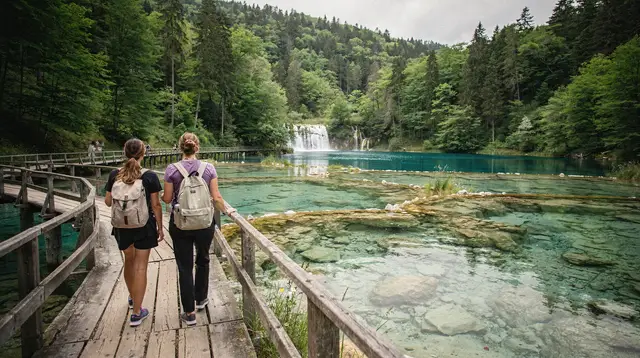
Plitvice Lakes National Park and Krka National Park both charge an entrance fee that is separate from however you get there. Add a bus, a private transfer, or a full guided day trip from Zadar, and the total for a single day easily exceeds what a typical day inside the city would cost. Because ticket prices and booking rules change from season to season — and both parks now require or strongly encourage booking a timed entry in advance — this guide will not print a specific euro figure for either park.
Instead, check the live price and availability on the official park channel or on a current Plitvice Lakes day trip listing or Krka day trip listing before you commit a date. If you can only justify one of the two parks on a tight budget, the Krka vs Plitvice comparison is worth reading first.
Kornati National Park works differently again. It is a scatter of largely uninhabited limestone islands and islets with no roads and no bridge to the mainland, so the only way in is by boat — either a paid group excursion or a private charter. There is no economical backdoor into Kornati; if it’s on your list, budget for it as a single, deliberate splurge day rather than trying to bundle it in cheaply. A Kornati boat tour from Zadar or a Kornati–Telašćica combo tour are the usual ways in; both are priced as excursions, not ferry tickets, because they include the boat, the route through the park, and often lunch or swim stops.
The practical takeaway: decide in advance which one or two of these bigger days you actually want — Kornati, Plitvice, Krka, or an island-hopping boat day — rather than trying to fit all of them into a short trip. Spreading a fixed number of “expensive days” across a longer stay, with cheaper Old Town days in between, tends to produce a more comfortable budget than trying to do everything back to back.
What costs nothing (or very little) in Zadar itself
A surprising amount of what makes Zadar worth visiting is free. The Old Town peninsula can be walked end to end in an afternoon, taking in the Roman Forum, the pre-Romanesque St Donatus Church, Five Wells Square and the Renaissance Land Gate. The Sea Organ (Morske orgulje) and the Greeting to the Sun (Pozdrav Suncu), both on the Riva, cost nothing to experience and are arguably the city’s signature attraction — sitting on the stone steps at sunset to listen to the organ is a free activity that regularly gets singled out as a highlight, tied to the popular (if unverified) story that Alfred Hitchcock once called Zadar’s the most beautiful sunset in the world.
Paid extras inside the Old Town are smaller and more optional: climbing the bell tower of the Cathedral of St Anastasia for a view over the rooftops, or joining a guided walking tour that adds context to the Roman and Venetian layers of the city, such as the Zadar a Pilgrim’s Path Guided Walking Tour. Rather than link that directly, book it properly through a guided walking tour through Zadar’s old streets, which is a low-cost way to get orientation and history in a single morning without needing a car or a paid excursion.
Getting around the Old Town itself costs nothing — it’s pedestrian at its core — and even the walk out to Vransko Lake or a short ferry hop to Ugljan are inexpensive compared to a full-day organized excursion.
Where the money actually goes on a longer trip
Beyond the parks and the boats, a few other categories shape a Zadar budget:
- Accommodation is usually the largest recurring cost on a multi-day trip, and it swings with the season — expect higher rates in the July–August peak than in the May–June or September–October shoulder seasons. See where to stay in Zadar for how neighborhoods compare on price and convenience.
- Ferries to the islands (Ugljan, Pašman, Dugi Otok) are generally inexpensive compared with organized boat tours, since they’re public transport rather than a chartered excursion — useful if you want to see an island without paying for a guided trip. See the ferries from Zadar to the islands guide for routes.
- Car rental adds a fixed daily cost plus fuel and parking, which only pays off if you’re covering ground the ferries and buses don’t reach well, such as Nin, Pag, or the Zrmanja river country. The car rental in Zadar guide and the bus from Zadar to Plitvice and Krka guide lay out the trade-off.
- Food varies enormously by location — restaurants directly on the Riva and around the main squares are priced for the view, while bakeries, markets and supermarkets a short walk away cost noticeably less. Mixing self-catering with a smaller number of sit-down meals is the main lever most budget travelers use here.
- Airport transfers between Zadar Airport (ZAD) at Zemunik and the Old Town are a small, predictable cost worth planning rather than improvising on arrival — see the Zadar airport transfer guide.
None of these categories has a single “right” number worth printing here, since prices move with the season, the operator and the year. For anything time-sensitive — a specific ticket price, a specific tour cost, a specific room rate — check the live listing rather than trusting a fixed figure in a guide, this one included.
A sample way to structure a budget-conscious week
Rather than a day-by-day cost table (which would only be accurate for the week it was written), it helps to think in terms of a splurge-to-simple ratio: pick one or two bigger days, and fill the rest with free or low-cost Old Town time.
| Day type | What it usually includes | Relative cost |
|---|---|---|
| Old Town day | Walking, Sea Organ, Forum, free beaches, self-catered meals | Low |
| Island ferry day | Public ferry to Ugljan or Pašman, walking, local lunch | Low–moderate |
| Guided walking or kayak day | A single paid activity in or near Zadar | Moderate |
| National park day (Plitvice or Krka) | Entrance fee + transport, often a full-day tour | High |
| Kornati boat day | Chartered or group boat excursion, no low-cost alternative | High |
A three-day budget Zadar itinerary puts this into a concrete plan, and the how many days to spend in Zadar guide helps decide how long a trip needs to be to fit in one or two of the pricier days without feeling rushed.
If you want to add one paid activity inside Zadar itself without going all the way to a national park day, a sunset kayak session is a good middle ground — a guided evening kayak trip along the Zadar waterfront costs less than a full-day excursion but still delivers a standout view of the sunset from the water.
Stretching a Zadar budget without missing the highlights
A few habits make the biggest difference:
- Walk first, book second. The Old Town, the Sea Organ, the Greeting to the Sun and the Roman Forum are all free, and they’re arguably the most iconic part of a Zadar visit anyway.
- Pick one national park, not both, if budget is tight. Plitvice and Krka are both worthwhile, but doing both on a short, budget-focused trip usually means the entrance fees and transport dominate the whole itinerary. The Krka vs Plitvice comparison can help decide.
- Treat Kornati as a deliberate splurge. There’s no cheap way in, so plan for it rather than being surprised by the cost.
- Use ferries over chartered boats when you just want to see an island. A ferry to Ugljan or Pašman costs far less than a boat tour and still gets you off the mainland.
- Shift toward shoulder season if your dates are flexible. May–June and September–October tend to bring lower accommodation rates and a calmer Old Town than the July–August peak — see the best time to visit Zadar guide.
- Mix self-catering with sit-down meals. Bakeries, markets and supermarkets away from the main tourist strip cost less than restaurants directly on the Riva.
- Book time-sensitive tickets ahead, but check the current price first. Plitvice and Krka both use timed or seasonally managed entry, and prices are not fixed year to year — check the listing before you travel rather than budgeting from memory or an old post.
For travelers who want one paid extra offshore without the full Kornati price tag, a shorter private option can work well too: a private boat trip out to Ugljan island is a smaller-scale way to get out on the water and back the same afternoon.
Zadar budget travel: frequently asked questions
Does Croatia use the euro or the kuna?
Croatia has used the euro (€) since 1 January 2023, when the kuna was retired. Any price you see quoted in kuna is outdated; budget and pay in euros.
What is the single biggest expense for a Zadar trip?
For most visitors it is either a boat excursion to the Kornati islands or a day trip to Plitvice Lakes or Krka National Park. Both combine national park entrance fees with transport, and often a guide, which adds up compared to a day spent walking Zadar’s Old Town.
Is the Old Town of Zadar free to visit?
Walking the Old Town, the Riva promenade, the Sea Organ and the Greeting to the Sun costs nothing. Paid extras are things like climbing the cathedral bell tower or joining a guided walking tour.
Are Plitvice Lakes and Krka National Park worth the entrance fee?
Both are widely considered highlights of the region, but the entrance fee, plus transport from Zadar, makes them the priciest single days most travelers build into a Zadar itinerary. Check the current ticket price on the official park channel or on a tour listing before you go, since fees and booking rules change.
Can I visit Kornati National Park cheaply?
Not really. Kornati has no roads or bridges, so the only way in is by boat, which means either a paid group excursion or a private charter. There is no low-cost way to reach the park.
Is it cheaper to visit Zadar in the shoulder season?
Accommodation and some tours are typically less expensive outside the July–August peak, and the milder weather in May, June, September and October also suits walking and sightseeing. Check current listings for season-specific pricing rather than relying on a fixed figure.
Do I need a car to keep costs down in Zadar?
Not for the Old Town itself, which is walkable and car-free at its core. A car (or organized transport) becomes more relevant for trips to Plitvice, Krka, Nin or Pag, where public transport options are limited or slower.
How can I save money on food in Zadar?
Mixing self-catering — bakeries, markets, supermarkets — with a smaller number of sit-down meals is the main lever, since restaurant prices along the Riva and in the Old Town core run higher than those a short walk away.
Planning Guides
Verified deep-linked GetYourGuide tours. Book through these links and we earn a small commission at no cost to you.
GetYourGuide does not provide a product photo for this activity — the image shows the meeting point, photographed by us.