3 Days in Zadar on a Budget: No Car Needed
Why this route works on a tight budget
Three days is enough to see the best of North Dalmatia without a rental car, without the surcharges that come with driving in a walled Old Town, and without the two priciest line items in most Zadar itineraries: a Plitvice Lakes entry ticket and a day of car hire. This plan swaps both out. Day 1 stays entirely inside Zadar, where the two free landmarks on the Riva do more for the trip than anything you could buy a ticket for.
Day 2 heads to Nin, a short hop north that a local bus covers for a few euros each way. Day 3 chooses Krka National Park over Plitvice — not because Krka is lesser, but because it is roughly 85–90 km from Zadar against Plitvice’s 120–130 km, meaning a shorter bus ride, a cheaper group tour, and more of the day left for the waterfalls themselves rather than the road.
If you have more time or a bigger budget and want to fit Plitvice in too, see how many days to spend in Zadar or the fuller budget travel guide for tradeoffs. This itinerary sticks to three days and skips it on purpose.
Day 1: Zadar Old Town, on foot and free
Base yourself in the Old Town or just outside it — see where to stay in Zadar for budget-friendly areas — and spend the whole day walking. Nothing on this list costs an entry fee.
Start at the Land Gate, the Renaissance-era gate from 1543 that was once the main entrance through the Venetian walls. These fortifications, together with St Nicholas Fortress in Šibenik, are part of a UNESCO World Heritage listing for Venetian defensive works — worth knowing as you walk past the stone, even if you never book a guided tour of it.
Head into the centre toward the Roman Forum, described as the largest on the eastern Adriatic, and the round pre-Romanesque St Donatus Church beside it — a 9th-century building no longer used for worship, its plain stone interior open to walk into. The Cathedral of St Anastasia is next door; the bell tower can be climbed for a small fee if you want one paid stop in an otherwise free day, but it isn’t required to enjoy the square. Five Wells Square, a short walk away, is worth passing through on the way toward the water.
Save the Riva itself for late afternoon. The Sea Organ (Morske orgulje), built in 2005 by architect Nikola Bašić, is a set of 35 pipes under marble steps that sound purely from waves and sea movement — no wind, no electricity, no ticket. A few steps further along, the Greeting to the Sun (Pozdrav Suncu), by the same architect, is a 22 m circle of roughly 300 glass solar panels that quietly charges through the day and lights up in patterns after dark.
Time your visit so you’re sitting on the Riva as the sun goes down: this is the spot Alfred Hitchcock is often said to have called the most beautiful sunset in the world — a popular story rather than a documented quote, but a fitting one to have in mind while the Greeting to the Sun switches on. Read the fuller story of both landmarks in how the Sea Organ works and the Hitchcock sunset legend.
If your legs have more in them after dark, a short evening walk along the walls costs nothing and the Old Town is calm and well lit. For a free alternative to a paid walking tour, see the free walking tour guide; if you’d rather have a guide fill in the history as you go, a low-cost history walking tour past the Roman Forum is the one paid option worth weighing on an otherwise no-spend day.
Day 2: Nin by local bus
Nin sits about 15 km north of Zadar, close enough that a rental car adds cost without adding much time saved over the bus. Local buses run from Zadar’s main bus station to Nin regularly through the day and the fare is a few euros each way — check the current timetable locally rather than relying on a fixed schedule, since frequency shifts between summer and off-season.
In Nin, the centre of the visit is the 9th-century Church of the Holy Cross, popularly nicknamed the “smallest cathedral in the world” — a nickname, not an official title, but the building earns the visit regardless. Nearby stands a bronze statue of Gregory of Nin by Ivan Meštrović, a copy of the original in Split; rubbing the toe for luck is a local tradition.
The old town itself is tiny and walkable in under an hour, so there’s time left for the Nin salt pans (Solana Nin), still worked using traditional methods, and — weather permitting — the shallow, sandy Queen’s Beach, which costs nothing to enter. For the fuller picture of the salt pans and the town’s healing mud tradition, see Nin salt and healing mud.
If you’d rather not manage bus timetables on a set schedule, a short guided visit bundles the transport and the history into one block of time:
a guided half-day exploring Nin’s old town and salt-pan traditionsReturn to Zadar by the afternoon or early evening bus and use the rest of the day to rest before the longer trip on Day 3. For more on getting around without a car, see the Zadar budget travel guide and the euro and Schengen basics for practical money notes.
Day 3: Krka National Park, not Plitvice
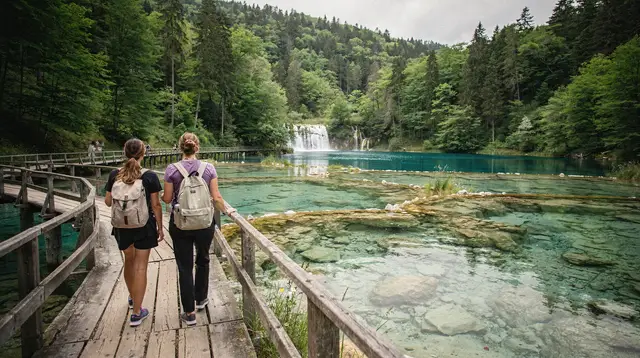
This is the deliberate budget swap in the itinerary. Plitvice Lakes is the better-known park and its 16 terraced lakes are genuinely spectacular, but it sits roughly 120–130 km from Zadar — about two hours each way by road — and its peak-season tickets are timed and priced higher than Krka’s. Krka National Park is roughly 85–90 km from Zadar, about an hour and fifteen minutes by road, which makes it reachable by scheduled bus or a lower-cost group tour rather than requiring a private car or a full-day premium excursion. For the side-by-side reasoning, see Krka vs Plitvice: which to choose and is Plitvice worth it in August if you’re still weighing the two.
The easiest budget route into the park is via Skradin, the small riverside town from which boats run to the park’s best-known feature, the Skradinski buk waterfall. A guided day tour from Zadar typically bundles the Skradin boat transfer with the park entry, which is simpler and often cheaper than arranging bus connections and a separate ticket yourself:
a day tour from Zadar to Krka via Skradin, with the boat transfer includedOne rule to know before you go: swimming has been banned at Skradinski buk since 2021, and it is a standing rule, not a seasonal one — treat the water as a photo stop rather than a place to cool off, whatever the crowds around you are doing. Read the background in Krka after the swimming ban. Beyond the main waterfall, the park also holds Roški slap and the island monastery of Visovac, both reachable from the standard park boat routes if your tour includes them.
If you’d rather see the park’s northern section and skip the busier Skradin boat queues, an entry route via Roški slap is a lower-key, often cheaper alternative:
a Krka National Park entry route via Roški slapBudget travellers who want to combine the park visit with lunch on a fixed price, rather than buying food separately in Skradin, can also look at a picnic-inclusive option:
a Krka waterfalls day trip with a picnic lunch includedReturn to Zadar in the evening — most Krka day tours are timed to have you back by early evening, leaving time for a final walk along the Riva before you leave.
Budget snapshot
| Day | Destination | Transport | Main cost |
|---|---|---|---|
| 1 | Zadar Old Town | On foot | Free (optional cathedral tower fee) |
| 2 | Nin | Local bus or short guided visit | Bus fare or low-cost tour |
| 3 | Krka National Park via Skradin | Scheduled bus or budget group tour | Park entry + transport, bundled on a tour |
Frequently asked questions about this 3-day budget Zadar itinerary
Do I need to rent a car for this itinerary?
No. Day 1 is entirely on foot within Zadar’s Old Town. Day 2 to Nin and Day 3 to Krka National Park are both reachable by local bus or a low-cost group tour, which is usually cheaper than a day of car rental plus parking.
Why Krka instead of Plitvice on a budget trip?
Krka National Park is roughly 85–90 km from Zadar, about a 1 hour 15 minute drive, against Plitvice’s 120–130 km and roughly 2 hours. The shorter distance means cheaper transport options and more time at the park itself within a single day, which suits a tight three-day budget schedule better than Plitvice does.
Can I swim at Krka National Park?
No. Swimming has been banned at the Skradinski buk waterfall since 2021, and this is a standing rule rather than a seasonal one. Treat the water as a sight to photograph, not a place to cool off.
How much does the bus to Nin cost from Zadar?
Nin is about 15 km from Zadar and local buses run the route for a few euros each way. Exact fares and frequency should be checked locally, since schedules vary between summer and off-season.
Are the Sea Organ and Greeting to the Sun really free?
Yes. Both are public installations on Zadar’s Riva with no entry fee, open at all hours. The Sea Organ sounds from wave movement alone, and the Greeting to the Sun charges from daylight and lights up after dark.
Is this itinerary possible outside summer?
Yes, and it may be cheaper and quieter outside July–August. Bus frequency to Nin can be reduced in the off-season, so check timetables before you go, and pack for cooler weather since this plan relies on walking and outdoor sightseeing each day.
What currency is used and do I need to worry about borders?
Croatia uses the euro and has been in the Schengen area since 1 January 2023, so there are no currency exchange fees to budget for and no separate border formalities if you’re arriving from another Schengen country.
Could I add Plitvice if I extend this trip by a day?
Yes — see how many days to spend in Zadar for how a fourth day usually gets allocated, and Krka vs Plitvice if you’re deciding whether to swap Krka for Plitvice or do both.
Planning Guides
Verified deep-linked GetYourGuide tours. Book through these links and we earn a small commission at no cost to you.
GetYourGuide does not provide a product photo for this activity — the image shows the meeting point, photographed by us.