Zadar vs Split: Which Should Be Your Dalmatia Base?
Should I base myself in Zadar or Split for North Dalmatia?
Zadar sits closer to Kornati National Park, Plitvice Lakes, Krka National Park and Nin, making it the more efficient base for those trips. Split works better as a base for central and southern Dalmatia, including Hvar, Brač and the road toward Dubrovnik. The two cities are about 160 km apart via the A1 motorway, and each has its own airport.
Two Dalmatian bases, two different trips
Zadar and Split both sit on Croatia’s Dalmatian coast, both have historic peninsulas built for walking, and both have their own international airport. That similarity is exactly why they get compared so often — and why the comparison matters more than it first appears. Pick the wrong base and you can add hours of driving to trips that should be short hops. Pick the right one and Kornati, Plitvice, Krka and Nin all become half-day or full-day outings rather than major undertakings.
The short version: the two cities are about 160 km apart by road, mostly via the A1 motorway, and each is served by its own airport — Zadar Airport (ZAD) at Zemunik for Zadar, and Split Airport near Kaštela for Split. Neither is a suburb of the other; they are genuinely separate bases with different strengths, and this guide walks through what each one actually gets you.
If you’re still deciding how long to stay once you’ve picked a base, how many days to spend in Zadar is worth reading alongside this one.
The core geography, in plain terms
North Dalmatia’s headline sights — the Zadar Archipelago, Kornati National Park, Nin, Pag, Plitvice Lakes and Krka — cluster around Zadar, not Split. Split sits about 160 km south, closer to central and southern Dalmatia: Hvar, Brač, Vis, and the long coastal road toward Dubrovnik.
That means the honest way to frame the choice isn’t “which city is better” — it’s “which region do you actually want to cover.” A trip built around Kornati, Plitvice, Krka and the islands off Zadar is a Zadar trip. A trip built around Hvar’s beach clubs, Brač’s Zlatni Rat and the run south toward Dubrovnik is a Split trip. Plenty of travelers do both, using the A1 to move between them partway through the itinerary — see day trip from Zadar to Split if you’re weighing a one-day visit rather than a full relocation.
Getting there: two separate airports
This is the detail that trips up a lot of planners. Zadar and Split are not served by one shared airport — each has its own, and flight schedules, airlines and seasonal routes differ between them.
- Zadar Airport (ZAD) sits at Zemunik, roughly 8–10 km from Zadar’s Old Town — a short transfer.
- Split Airport sits near Kaštela, a similar short distance from central Split.
Neither airport is a substitute for the other, and the drive between them is the same roughly 160 km, two-hour A1 route that connects the two cities on the ground. Before booking flights, compare routes into both airports rather than assuming one city is the only entry point to North Dalmatia — for the Zadar side specifically, see the Zadar Airport transfer guide and getting from Zadar Airport to the Old Town.
Travelers splitting a trip between the two cities commonly use a direct coach rather than renting a car for a one-way hop. A bus connecting Split’s and Zadar’s city centers covers the A1 route without the logistics of a one-way car rental.
Why Zadar is the more efficient base for the national parks
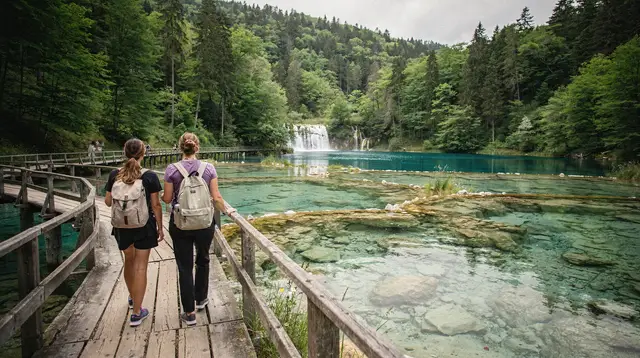
This is the clearest, most concrete advantage Zadar holds, and it’s worth stating plainly: from Zadar, Plitvice Lakes National Park is roughly 120–130 km away, about two hours by road; Krka National Park is roughly 85–90 km away. Both are workable as day trips without an overnight stop. A Plitvice Lakes day trip from Zadar and a Krka National Park day trip from Zadar are both standard, well-trodden itineraries.
Split can also reach both parks, but Zadar’s shorter distances generally make for less time on the road and more time at the parks themselves — a meaningful difference if you’re trying to see more than one park in a single trip, or combining a park visit with a coastal stop. If you’re deciding between the two parks rather than the two cities, Krka vs Plitvice — which to choose covers that separately.
A guided option removes the driving question entirely: a guided day tour of Plitvice Lakes handles transport and timed entry, which matters in the July–August peak season when tickets are sold in timed windows.
Kornati and the archipelago: boat-only, and Zadar-adjacent
Kornati National Park has no roads or bridges connecting it to the mainland — it’s reached only by boat, and departures run from Zadar, Biograd na Moru, Murter or Sali, all of them close to Zadar rather than to Split. That single fact does more to settle the Zadar-vs-Split question for archipelago-focused trips than almost anything else here: if Kornati, Telašćica Nature Park, Dugi Otok’s Sakarun beach or the smaller islands of Ugljan and Pašman are on your list, Split adds a meaningful amount of extra travel to reach the same departure ports.
For a first look at the islands close to Zadar without committing to the full Kornati run, a private boat trip to Ugljan island is a shorter option, and paddling from the Old Town itself is possible with a kayak tour around Zadar’s coastline.
Nin, Pag and the coast north of Zadar
Nin, about 15 km north of Zadar, and Pag island are both naturally paired with a Zadar base rather than a Split one — the Nin day trip from Zadar and Pag island day trip from Zadar guides both start from Zadar’s Old Town. From Split, both destinations require backtracking north along the same A1 corridor, adding time that a Zadar base avoids.
What Split covers that Zadar doesn’t
None of this makes Split the weaker choice overall — it depends entirely on what’s on your itinerary. Split’s own historic core, built around Diocletian’s Palace, is a major draw in its own right, and Split sits closer to central and southern Dalmatian islands like Hvar, Brač and Vis, as well as the long coastal drive toward Dubrovnik. If those places are the priority, Split is the more efficient base by the same logic that makes Zadar efficient for the north: shorter distances to the things you actually want to see.
Šibenik and Krka National Park sit roughly between the two cities and work reasonably well from either base — a tour of Šibenik’s St Nicholas Fortress and Tijat island is a manageable day trip whether you’re staying in Zadar or Split.
Do you need a car in either base?
Both Old Towns are pedestrian cores where a car is dead weight rather than an asset — Zadar’s peninsula and Split’s Diocletian’s Palace district are both walkable on foot, and neither city wants a rental car parked anywhere near its historic center. The question is really about the day trips leading out from whichever base you pick.
From Zadar, several of the highest-value excursions run without a car at all: boat departures to Kornati, Telašćica and the archipelago leave straight from the harbor, and guided coach tours cover Plitvice and Krka with pickup included. A car earns its keep mainly for Nin, Pag and the inland Velebit–Zrmanja country, where public transport is thinner and a morning without a fixed tour schedule is worth more. If you’re weighing that decision in detail, the car rental in Zadar guide breaks down when it’s worth it and when it isn’t.
From Split, the calculus tilts more toward renting, simply because the southern islands and the Dubrovnik road involve longer, less frequently served routes than the boat-heavy, short-hop geography around Zadar.
Moving between the two cities without a rental
The A1 motorway is the backbone connecting Zadar and Split, and travelers who want to cover both without committing to a one-way car rental generally have two practical options: a direct intercity coach, or a private transfer. The coach route is well established and the frequency is generous enough that booking a fixed departure day ahead, rather than same-day, is usually all the planning it needs — see the bus connecting Split’s and Zadar’s city centers above for the specifics.
Renting a car one-way between the two airports is also possible, but one-way drop fees can make it noticeably more expensive than a round-trip rental picked up and returned in the same city — worth checking before assuming it’s the cheaper option.
Weather, season and how it shifts the decision
The two cities share the same Adriatic climate — hot, dry summers and mild, wetter winters — so season doesn’t change the underlying geography argument much. What it does change is timing pressure. In July and August, Plitvice Lakes sells entry in timed windows and Krka’s peak-season crowds are heaviest around midday, so the shorter drive from Zadar becomes more valuable, not less: less time on the road means more flexibility to work around ticket times.
Outside peak season, both Zadar’s and Split’s drive times to the parks matter less, since crowding and timed entry pressure ease off. For a closer look at when to go, best time to visit Zadar covers the shoulder-season and summer trade-offs in more detail.
Budget considerations
Neither city is dramatically cheaper than the other on accommodation or food — both are established Dalmatian coastal destinations with a wide range of options from hostels to boutique hotels. The cost difference that actually shows up in a trip budget is transport: a Zadar base with day trips built around short boat rides and sub-two-hour drives to Plitvice and Krka tends to mean less spent on fuel, tolls and transfer time than a Split base reaching the same parks, simply because the distances are shorter. Travelers planning tightly around cost can find more detail in the Zadar budget travel guide.
Side-by-side comparison
| Zadar | Split | |
|---|---|---|
| Distance between the two | ~160 km via the A1 | ~160 km via the A1 |
| Own airport | Zadar Airport (ZAD), Zemunik | Split Airport, near Kaštela |
| Old town style | Roman Forum, Sea Organ, compact peninsula | Diocletian’s Palace, larger historic core |
| Closer national parks | Plitvice (~120–130 km), Krka (~85–90 km) | Both reachable, generally longer drives |
| Kornati boat departures | Zadar, Biograd na Moru, Murter, Sali — all nearby | Farther from these ports |
| Closer coastal towns | Nin, Pag, Novalja | Trogir, and the run toward southern islands |
| Better base for | North Dalmatia: islands, Kornati, Plitvice, Krka, Nin | Central/southern Dalmatia: Hvar, Brač, Dubrovnik road |
No flight prices or fare comparisons are included here deliberately — airline routes and seasonal pricing change too often to state reliably in a guide. Check current fares into both ZAD and Split Airport directly when you book.
Choosing based on your itinerary, not the city’s reputation
A useful way to decide: list the specific places you want to visit, then check which city each one sits closer to. If Kornati, Plitvice, Krka, Nin, Pag or the Zadar Archipelago dominate that list, Zadar is the more efficient base — you’ll spend less time driving and more time at the destinations themselves. If Hvar, Brač, Trogir or the road toward Dubrovnik dominate, Split serves that itinerary better.
Travelers with more time often do both: base in Zadar first for the national parks and islands, then move south to Split for a few days, using the A1 or a direct coach to cover the roughly 160 km between them partway through the trip. For planning the Zadar half specifically, where to stay in Zadar and the direct comparison in Zadar vs Dubrovnik as a base cover the neighboring decisions this one tends to raise.
FAQ: Zadar vs Split as a base
How far apart are Zadar and Split?
Roughly 160 km by road, mostly via the A1 motorway, which typically takes around two hours depending on traffic and stops.
Do Zadar and Split each have their own airport?
Yes. Zadar is served by Zadar Airport (ZAD) at Zemunik, a short distance from the Old Town. Split is served by Split Airport, near Kaštela. They are separate airports with separate flight schedules, so check both when comparing routes.
Which city is closer to Plitvice Lakes National Park?
Zadar is closer, at roughly 120–130 km, around two hours by road. Split is farther inland from Plitvice, which makes a day trip from Zadar generally more time-efficient.
Which city is closer to Krka National Park?
Both cities sit within reach of Krka, but Zadar is roughly 85–90 km away, making it a convenient base for a day trip. Split is also commonly used as a Krka base, so compare actual driving times for your specific itinerary.
Can I visit Kornati National Park from Split?
Kornati is reached only by boat, and most boat trips depart from Zadar, Biograd na Moru, Murter or Sali — all on the North Dalmatian coast near Zadar. Split is farther from these departure points, so Zadar is the more direct base for Kornati.
Is it possible to combine Zadar and Split in one trip?
Yes. Many travelers base in one city, cover the nearby national parks and islands, then transfer to the other by bus or car along the A1 for the second half of the trip.
Which city has the more walkable old town?
Both have compact historic cores built for walking. Zadar’s peninsula centers on the Roman Forum, St Donatus Church and the Sea Organ on the Riva; Split’s is built around the Diocletian’s Palace complex. Neither requires a car to explore on foot.
Does Croatia use the euro and is it in Schengen?
Yes to both. Croatia adopted the euro and joined the Schengen area on 1 January 2023 (air borders followed on 26 March 2023), so this applies equally whether you base in Zadar or Split.
Tour Comparisons
Verified deep-linked GetYourGuide tours. Book through these links and we earn a small commission at no cost to you.
GetYourGuide does not provide a product photo for this activity — the image shows the meeting point, photographed by us.