Pag Island Day Trip from Zadar
Is Pag island a good day trip from Zadar?
Yes. Pag island connects to the mainland by the Pag Bridge in the south and the Prizna–Žigljen ferry in the north, and its Old Town, lace tradition, sheep cheese and bare limestone landscape make it a distinct day out. Pag town itself is quiet and historic; the beach-club scene at Novalja, further north on the island, is a separate destination.
An island of salt, lace and bare stone
Most first-time visitors picture Croatia’s Adriatic islands as green with pine forest, and Pag breaks that picture on purpose. Long stretches of the island are exposed white limestone, scoured bare by the bora wind that funnels down off the Velebit mountains on the mainland. The result is often called a lunar or moon-like landscape, and it is one of the most distinctive sights in North Dalmatia. This guide covers a day trip to Pag from Zadar: how to get onto the island, what to see in Pag town, and why the island’s two signature products — lace and cheese — are worth building the day around.
Getting onto the island
Pag connects to the Croatian mainland in two places, and it helps to know both before you plan a route.
In the south, the Pag Bridge (Paški most) carries the road directly across a narrow channel onto the island. This is the crossing used by most day trips from Zadar, since it sits on the more direct route south along the coast.
In the north, the Prizna–Žigljen ferry operated by Jadrolinija crosses a short strait between the mainland and the island’s northern tip. This route matters most if you are coming from or continuing toward the Velebit coast or Rijeka direction, or building a longer loop that takes in both ends of the island.
Do not guess at ferry timetables or crossing durations — schedules on this route change by season, and the only reliable source is a live timetable or a booked tour that already accounts for it. If you would rather not plan the crossing yourself, a guided option such as the Pag Old Town walking tour takes care of the transport and delivers you straight into the historic centre.
Pag town: salt, walls and a walkable centre
Pag town itself is compact, quiet by comparison with the coastal resorts further south, and built around a long history of salt production — the island’s saltworks are still active and remain one of its economic backbones. The old centre has a walled, planned layout, and wandering it on foot is the easiest way to get a feel for the place in a couple of hours.
A guided walk is a good way to get oriented quickly, especially since the town’s history — salt trade, Venetian-era influence, and its own distinct identity separate from Zadar’s — is not always obvious just from walking past the buildings. The Pag Old Town Walking Tour covers this ground with a local guide, which is worth doing before you go looking for lace and cheese on your own, so you know what you are looking at.
Pag lace: a UNESCO craft, not a souvenir shop item
Pag lace (paška čipka) is a fine, hand-worked needle lace made on the island for generations, and it was formally recognised by UNESCO as part of Croatia’s intangible cultural heritage in 2009. It is a different tradition from the Venetian defensive walls that protect Zadar and Šibenik, which carry a separate UNESCO listing from 2017 — the two are easy to conflate but recognise entirely different things: one a textile craft, the other a set of fortifications.
In Pag town, lace is often displayed and sold by the women who make it, working in doorways or small stalls around the old centre. Buying a piece here, directly from a maker, is a more meaningful way to take the craft home than picking one up from a generic souvenir stand elsewhere in Croatia.
Paški sir: the island’s other signature
Paški sir is a hard sheep’s milk cheese and one of the best-known cheeses in Croatia. Its sharp, salty character comes from the island’s own conditions: sparse pasture, sea-salt spray carried on the wind, and the wild herbs the sheep graze on across the bare terrain. It is worth tasting on the island itself rather than waiting to find it elsewhere, since quality and freshness vary once it travels.
Cheese tastings are often folded into boat trips and excursions around the island, alongside other local products. The Pag Island Excursion with Bay Cruise to Festini is one option that pairs coastal scenery with a stop built around island produce, and gives a different view of Pag than the walking tour alone.
Seeing the coastline: bays, cruises and the bare landscape from the water
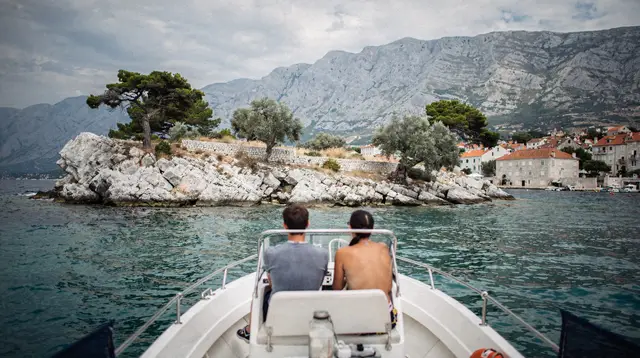
Because so much of Pag’s character comes from its stark, treeless coastline, seeing it from the water adds something a land-based visit does not. The island’s bays cut deep into the limestone, and the contrast between turquoise water and pale bare rock is sharper from a boat than from the road.
The Pag Bay Cruise is built around exactly this — a slower look at the coastline’s inlets and coves, useful if your day trip has time for both the town and the water. For visitors approaching from further up the island near Novalja, the Pag Island Sunset Motorcycle Tour to Stara Novalja is a different way to cover the terrain, combining the island’s open landscape with a sunset finish near Stara Novalja.
Don’t confuse Pag town with Novalja
One of the most common mix-ups in planning a Pag day trip is treating the island as a single destination when it actually holds two very different experiences.
Pag town, covered above, is historic, salt- and lace-focused, and quiet for most of the year. Novalja, further north on the island, is a separate town and the gateway to Zrće beach, home to Croatia’s best-known open-air beach clubs. Zrće’s clubs run in summer only — outside the summer season the beach and surrounding venues are largely closed or empty, so a trip timed around nightlife needs to land in the right months. If your interest is Pag’s history, lace and cheese, build the day around Pag town; if it is Zrće’s clubs, the trip is really about Novalja, and the two should not be planned as the same stop.
Timing the day: when to go
Pag rewards different seasons in different ways. In spring and early autumn, the lacemakers’ stalls and the old town are quieter and easier to explore at a walking pace, and the bora-scoured landscape reads even starker against a low sun. In high summer, Pag town itself stays manageable, but the roads north toward Novalja fill up with traffic heading for Zrće beach, so a day trip focused on the historic centre and the salt pans is best planned as a morning start, before the coastal roads get busy. If your priority is the beach clubs rather than lace and cheese, that is really a separate trip built around Novalja’s summer season, not the Pag town day covered here.
What to pair Pag with
A single day on Pag leaves time to add a second stop if you start early. Nin, with its own salt pans and a much smaller historic core than Pag town, sits on the way back toward Zadar and is the most natural pairing — both towns share salt as an economic backbone, which makes the comparison more interesting than pairing Pag with an unrelated stop. If you would rather stay closer to Zadar and compare it against the full menu of options, the best day trips from Zadar guide lays out how Pag stacks up against Kornati, Plitvice and the rest.
For a food-focused angle on the same island, the Pag cheese and lace tradition piece goes deeper into both crafts than this guide has room for, and is worth reading before you go if you want to know what to look for when buying either. Travellers building a longer trip around Zadar’s food and wine more broadly can also look at the Zadar food and wine tour and the wine and olive oil tasting near Zadar guide, though neither is specific to Pag.
If Pag is your only full day away from the city, it is worth first getting oriented in Zadar’s own Old Town on a separate morning or evening, since the contrast between Zadar’s Roman-and-Venetian core and Pag’s salt-and-lace identity is part of what makes both worth seeing. Travellers still deciding how many days to allocate to the wider area can check how many days to spend in Zadar before committing Pag to the itinerary.
Where Pag fits with the rest of North Dalmatia
Pag sits alongside Nin in the Pag–Nin corner of North Dalmatia, and the two make sense as a combined route if you have more than a single day. Nin, a short distance north of Zadar, has its own salt pans and a very different, much smaller historic core; pairing a stop there with Pag makes for a fuller look at how salt, in particular, has shaped this stretch of coast for centuries. If you are building a longer plan, the Pag–Nin itinerary sketches out how the two combine over a couple of days.
Compared with the islands of the Zadar Archipelago — mostly green with pine, farmland or scrub — Pag’s bare limestone stands out as a genuinely different landscape within a short drive or boat ride of the same base. Travellers weighing up where to spend a day often ask how Pag compares to Kornati National Park; both are stark and boat-friendly, but Kornati is reachable only by water and has no permanent settlements, while Pag has a bridge, a ferry, and a living town at its centre.
Practical notes for planning the day
| Approach | Route | Best suited to |
|---|---|---|
| From the south | Pag Bridge (Paški most) | Most day trips from Zadar |
| From the north | Prizna–Žigljen ferry | Travellers coming from or heading toward Velebit / Rijeka |
| Guided, no driving | Booked tour from Zadar | Visitors who want transport and a guide handled together |
| Pag has to offer | Where |
|---|---|
| Historic old town, salt production | Pag town |
| Pag lace (UNESCO, 2009) | Pag town, sold by local lacemakers |
| Paški sir sheep cheese | Island-wide, tastings on excursions |
| Bare limestone “lunar” landscape | Across much of the island, especially inland roads |
| Zrće beach clubs (summer only) | Near Novalja, further north |
For exact departure times, crossing durations, ferry fares or entrance costs, treat this guide as an overview only and check a live tour or ferry listing before you travel — none of those figures are reliable enough here to plan a departure around.
If you are renting a car for the crossing rather than joining a guided tour, the car rental in Zadar guide covers what to expect when picking up a vehicle locally, and the Zadar airport to Old Town guide is useful context if Pag is one stop in a wider first- or last-day itinerary around the airport.
FAQ: planning a Pag island day trip
How do you get to Pag island from Zadar?
There are two routes onto Pag island. From the south, the Pag Bridge (Paški most) carries the road directly onto the island, which is the typical way in from Zadar. From the north, the Prizna–Žigljen ferry crosses a short strait from the mainland. Guided day trips from Zadar handle this routing for you; for exact schedules and journey times, check a live tour listing.
What is Pag lace?
Pag lace (paška čipka) is a fine needle-lace craft made by hand on the island for generations, recognised by UNESCO as intangible cultural heritage in 2009. It is typically displayed and sold around Pag town, often by the lacemakers themselves.
What is Paški sir?
Paški sir is a hard sheep’s milk cheese from Pag, known for a sharp, salty flavour shaped by the island’s sparse, wind-exposed pasture and the herbs the sheep graze on. It is one of Croatia’s best-known cheeses and a common thing to taste or buy on the island.
Is Pag island the same as Novalja?
No. Pag is the island; Novalja is one town on it, located further north from Pag town. Novalja is the gateway to the Zrće beach clubs, which operate in summer only, while Pag town itself is a quieter historic base built around salt production and lace.
Why does Pag island look so bare?
Much of Pag’s landscape is exposed white limestone with little vegetation, shaped over centuries by the strong bora wind and by grazing. The result is often described as a lunar or moon-like landscape, a striking contrast with the greener islands of the Zadar archipelago.
Can you visit Pag island without a car?
Yes. A guided day trip from Zadar is the simplest way to see Pag’s Old Town, lace and cheese without arranging your own transport across the bridge or ferry.
Are the Zrće beach clubs open all year?
No. The Zrće beach clubs near Novalja run in summer only; outside that season the beach and clubs are largely quiet, so a day trip planned around them should be timed to the summer months.
Boat Tours
Verified deep-linked GetYourGuide tours. Book through these links and we earn a small commission at no cost to you.
GetYourGuide does not provide a product photo for this activity — the image shows the meeting point, photographed by us.