Zadar vs Dubrovnik: Which Should You Choose?
Is Zadar or Dubrovnik better to visit?
Zadar sits much closer to Plitvice Lakes, Krka National Park and the Kornati archipelago, making it the stronger base for national-park day trips and island hopping. Dubrovnik, further south, is the classic choice for its walled Old Town and Game of Thrones fame. Both use the euro and sit inside Schengen, since Croatia joined both on 1 January 2023.
Two very different bases on the same coast
Zadar and Dubrovnik both sit on Croatia’s Adriatic coast, both have historic old towns built from pale stone, and both now use the same currency and border rules as the rest of the Schengen area. But they are not interchangeable stops on a checklist. They occupy different parts of the coastline, they open onto different clusters of islands and inland parks, and they suit somewhat different kinds of trip. This guide lays out the practical differences — location, day-trip access, islands, atmosphere and crowds — without inventing exact distances or prices that this brief does not include, so you can weigh what actually matters for your own itinerary.
If you’re choosing between the two as a single base, or wondering whether to combine them, the short version is this: Zadar is the stronger choice if national parks and island hopping are the priority, while Dubrovnik remains the reference point for a compact, dramatic walled Old Town. Neither is objectively “better” — they answer different questions.
Location: north versus south on the same coast
Zadar sits in North Dalmatia, on a peninsula jutting into the Adriatic, with Zadar Old Town as its historic core. Dubrovnik lies much further south along the coast, closer to the Croatia–Montenegro border than to Zadar. This guide won’t state an exact road distance between them, since that figure isn’t part of the confirmed facts here — but the direction is clear and matters more than the number: Dubrovnik is the southern anchor of the Dalmatian coast, and Zadar is the northern one.
That north–south position is the single biggest factor in how each city works as a base. Zadar’s location puts it within reach of a very different set of destinations than Dubrovnik’s does, and that difference shapes almost everything else in this comparison.
Why Zadar’s location matters for national parks
The most concrete advantage Zadar holds over Dubrovnik is proximity to Croatia’s two best-known national parks.
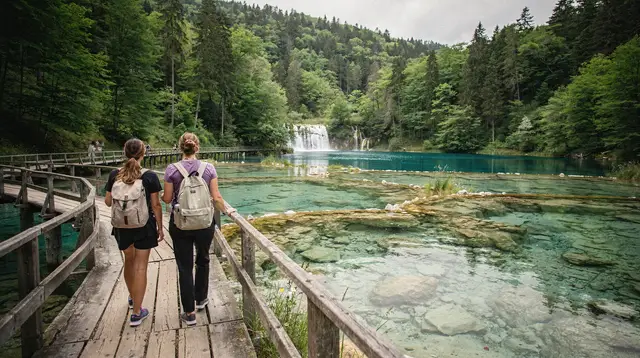
Plitvice Lakes National Park, with its sixteen terraced lakes and waterfalls, is roughly 120–130 km from Zadar, around a two-hour drive — close enough that it’s a standard day trip from a Zadar base. A Plitvice Lakes day trip from Zadar is one of the most booked excursions out of the city, and travelers who’d rather not self-drive can take a Plitvice Lakes: Guided Tour that handles transport and timed entry together.
Krka National Park sits even closer, roughly 85–90 km from Zadar, built around the Skradinski buk waterfall reached by boat from the town of Skradin. It’s realistic as a half-day or full-day trip from Zadar without much planning. See our Krka National Park day trip from Zadar guide, or the direct comparison in Krka vs Plitvice: which to choose if you’re weighing which park fits your schedule.
Dubrovnik can reach both parks too, but the drive is substantially longer in each direction, which typically rules out a comfortable day trip and pushes visitors toward an overnight detour instead. For travelers who want either park as an easy add-on rather than a logistics project, Zadar’s position is the deciding factor.
Why Zadar’s location matters for islands
The same logic extends offshore. Zadar opens directly onto the Zadar Archipelago — Ugljan, Pašman, Dugi Otok with its Telašćica Nature Park and Sakarun beach, and the uninhabited limestone islands of Kornati National Park.
Boats to Kornati leave from Zadar itself, or from Biograd na Moru and Murter nearby. A Kornati National Park boat tour from Zadar is a full-day outing that simply isn’t practical starting from Dubrovnik, given how far south Dubrovnik sits from these islands.
For a shorter outing closer to town, a Boat Tour in Zadar covers the coastline and nearby waters without committing to a full-day island run, and a Zadar: Kayak Tour is a good option for travelers who want to explore the coast under their own paddle power rather than from a larger boat. Travelers basing themselves nearer Biograd na Moru can book a Kornati National Park boat tour with lunch from Biograd na Moru as an alternative way into the archipelago.
Dubrovnik has its own nearby islands — the Elaphiti Islands and Lokrum among them — which this guide doesn’t cover in detail since they fall outside Zadar Trip’s territory. The point isn’t that Dubrovnik lacks islands; it’s that Zadar’s islands, the Kornati archipelago especially, are a different and larger draw, and only practical to reach from a northern base.
Šibenik and Krka: part of Zadar’s orbit, not Dubrovnik’s
South of Zadar but still well north of Dubrovnik sits Šibenik, a stone-built historic town best known for the UNESCO-listed Cathedral of St James and for four hilltop fortresses, one of which appeared as Braavos in Game of Thrones. Šibenik and Krka National Park sit close together, and both are realistic add-ons to a Zadar-based trip — see our Šibenik old town day trip from Zadar and, for the cathedral specifically, a Šibenik: St Nicholas Fortress and Tijat Island Tour.
Smaller coastal towns in the same stretch — Vodice, Primošten with its terraced Babić vineyards, and Murter — round out what’s sometimes called the Šibenik–Krka riviera. All of it sits within striking distance of Zadar and well outside a realistic day-trip radius from Dubrovnik.
What Dubrovnik offers instead
None of this makes Dubrovnik a weaker destination — it simply answers a different brief. Dubrovnik’s walled Old Town is one of the most recognizable historic centers on the Adriatic, and its global profile as a Game of Thrones filming location (King’s Landing) has made it a fixture on Croatia itineraries for over a decade. It’s compact, dramatic, and easily walked in a day or two, and it works well as a stand-alone city break without needing a car or a national-park detour.
Where Zadar spreads its appeal across a wider territory — city, archipelago, two national parks, a mountain and river valley inland — Dubrovnik concentrates its appeal into one dense, walkable historic core. Travelers who want one striking Old Town and don’t plan to chase waterfalls or uninhabited islands may find Dubrovnik the simpler, more self-contained choice.
Crowds and pace
Dubrovnik has a well-documented overtourism problem in peak season, driven partly by cruise-ship arrivals concentrated into a small walled area. Zadar’s Old Town, while increasingly popular, still tends to feel less crowded at the height of summer, partly because its territory is larger and visitor traffic spreads across the city, the archipelago and the inland parks rather than funneling into one small historic core. That’s a real difference in daily experience, even without a numerical crowd comparison — if you’ve read that Dubrovnik’s Old Town can feel packed in July and August, that reputation is well earned, and Zadar is the calmer counterpoint on this stretch of coast.
The euro and Schengen: no difference between them
One thing that has stopped being a variable across Croatia: currency and borders. Croatia adopted the euro (€) nationwide on 1 January 2023, retiring the kuna, and joined the Schengen area the same day (with air-border checks following on 26 March 2023). That means Zadar and Dubrovnik use exactly the same currency and the same border rules as each other and as the rest of Schengen Europe — there’s no currency-exchange planning or border friction to weigh between the two cities. For a fuller rundown, see our Zadar money and euro guide or the wider euro and Schengen Croatia travel guide.
A quick side-by-side
| Zadar | Dubrovnik | |
|---|---|---|
| Position on the coast | North Dalmatia | Further south |
| Plitvice Lakes | Close, common day trip | Considerably further, harder as a day trip |
| Krka National Park | Close, easy half/full day | Considerably further |
| Kornati archipelago | Boat access from Zadar, Biograd, Murter | Not a practical day trip |
| Old Town character | Smaller, Roman and Venetian layers, Sea Organ | Larger walled Old Town, internationally famous |
| Peak-season crowding | Present but spread across a wider territory | Well documented, concentrated in a small walled area |
| Currency | Euro (€) | Euro (€) |
| Schengen | Yes, since 1 January 2023 | Yes, since 1 January 2023 |
This table deliberately leaves out distances and prices that aren’t confirmed in this guide’s source material — treat it as a shape-of-the-trip comparison, not a spreadsheet of numbers.
Combining both in one trip
Plenty of travelers don’t choose one or the other — they combine Zadar and Dubrovnik into a single Dalmatian coast itinerary, often flying into one city and out of the other, or linking them by road or coastal ferry. If your schedule allows for both, that’s a reasonable way to see the north–south range of the coast: Zadar’s parks and islands first, then south to Dubrovnik’s Old Town, or the reverse. If you only have time for one, let your priorities decide: national parks and island hopping point to Zadar, a single iconic walled city points to Dubrovnik.
For help narrowing that decision further, see how many days to spend in Zadar and best time to visit Zadar, or compare Zadar against another common alternative base in Zadar vs Split as a base.
Getting between Zadar and Dubrovnik
Travelers combining both cities typically connect them by road along the coastal highway, by coach, or by coastal ferry services that link Dalmatian ports in season. This guide doesn’t state a fixed journey time or fare, since neither is part of the confirmed facts here — schedules and road conditions vary by season, and travelers should check current timetables rather than rely on a number quoted in an article.
What matters for planning purposes is the order: most itineraries treat Zadar and Split as a northern pairing and Dubrovnik as the southern endpoint, so a one-way route through the region (rather than backtracking) tends to be the more efficient use of time. If Split is also on your radar as a possible stop between the two, our day trip from Zadar to Split guide covers that particular leg in more detail.
However you connect the two cities, travelers basing themselves in Zadar first can fill those days with the archipelago and national-park excursions this guide already covers, saving Dubrovnik’s Old Town for the second half of the trip. A Kornati National Park boat tour with lunch from Biograd na Moru is a good example of the kind of full-day outing that only makes sense from a Zadar-area base, precisely because it isn’t reachable within a comfortable day from further south.
Which itinerary suits a Zadar-first trip
If Zadar is your first stop, or your only stop on this leg of the coast, the shape of your days depends on how much time you have and what you’d rather prioritize. A three-day Zadar archipelago and islands itinerary leans into the boat trips and island hopping that set Zadar apart from Dubrovnik, while a six-day road trip through North Dalmatia widens the scope to Pag, Nin, and the Šibenik–Krka riviera as well.
Travelers with more time who want to see the full range of what this stretch of coast offers, national parks included, can look at a seven-day grand tour of Zadar as a starting template to adjust.
None of these itineraries require choosing Zadar over Dubrovnik outright — they’re simply built around what a Zadar base makes easy, in the same way a Dubrovnik-based itinerary would be built around its own walled Old Town and nearby islands. Pick the template that matches your priorities, then decide separately whether Dubrovnik fits into the same trip or a different one.
Zadar vs Dubrovnik: your questions answered
Is Zadar closer to Plitvice Lakes than Dubrovnik is?
Yes. Zadar is the closer gateway to Plitvice Lakes National Park, which is why so many day trips to the park depart from Zadar rather than from Dubrovnik.
Does Zadar or Dubrovnik have better access to Krka National Park?
Zadar is considerably closer to Krka National Park than Dubrovnik is, making it easier to visit Krka as a half-day or full-day trip from a Zadar base.
Can I visit the Kornati islands from Dubrovnik?
The Kornati archipelago is reached by boat from Zadar, Biograd na Moru, Murter or Sali, all of which sit much closer to the islands than Dubrovnik does. Zadar is the practical base for a Kornati boat trip.
Do Zadar and Dubrovnik both use the euro?
Yes. Croatia adopted the euro across the entire country on 1 January 2023, replacing the kuna, so both Zadar and Dubrovnik use the same currency.
Is Dubrovnik further south than Zadar?
Yes, Dubrovnik lies further south along the Croatian coast than Zadar, which is one reason the two cities suit different itineraries.
Which city has the more famous Old Town, Zadar or Dubrovnik?
Dubrovnik’s walled Old Town is the more internationally famous of the two, partly through its Game of Thrones filming locations. Zadar’s Old Town is smaller and less crowded, with its own landmarks such as the Sea Organ and the Roman Forum.
Is Zadar cheaper than Dubrovnik?
This guide does not compare specific prices between the two cities. Both use the euro, and travelers should check current listings for accommodation, tours and dining rather than rely on a fixed price comparison.
Can I combine Zadar and Dubrovnik in one trip?
Yes, many travelers combine both, often flying into one city and out of the other, or connecting them by road or coastal ferry along the Dalmatian coast.
Tour Comparisons
Verified deep-linked GetYourGuide tours. Book through these links and we earn a small commission at no cost to you.
GetYourGuide does not provide a product photo for this activity — the image shows the meeting point, photographed by us.