Paklenica National Park Hiking: Canyons, Cliffs and the Velebit Trails
What is Paklenica National Park and why hike there?
Paklenica is a national park on the Velebit mountain slopes near Starigrad, established in 1949, centred on the Velika and Mala Paklenica limestone canyons. It draws hikers and climbers for its river-cut gorges, forested trails, mountain huts and the Anića kuk cliff, one of Croatia's best-known climbing walls.
A canyon park on the Velebit’s seaward face
Most visitors to North Dalmatia come for water — the Adriatic, the Zadar Archipelago, the waterfalls of Krka National Park and Plitvice Lakes. Paklenica National Park is the region’s answer for people who want rock and trail instead: a mountain park cut into the seaward slopes of the Velebit range, just inland from the small coastal town of Starigrad. Established in 1949, it’s one of Croatia’s oldest national parks, and it protects two deep limestone canyons — Velika Paklenica and Mala Paklenica — along with beech and pine forest, mountain huts, and a stretch of the Velebit ridge itself.
Unlike the terraced lakes at Plitvice or the cascading river at Krka, Paklenica is a park you walk into rather than photograph from a boardwalk. The main draw for most day visitors is Velika Paklenica, the larger of the two canyons, where a wide gravel path follows the dry riverbed between rising limestone walls. For climbers, the park’s signature feature is Anića kuk, a sheer cliff face inside Velika Paklenica that’s been a serious multi-pitch climbing destination for decades. For hikers with more time and stamina, marked trails continue up out of the canyon toward mountain huts and viewpoints on the Velebit proper.
This guide covers what’s actually in the park, how it’s organised, what to expect on the ground, and how it fits alongside the rest of a North Dalmatia trip based in Zadar.
Velika Paklenica: the canyon almost everyone visits
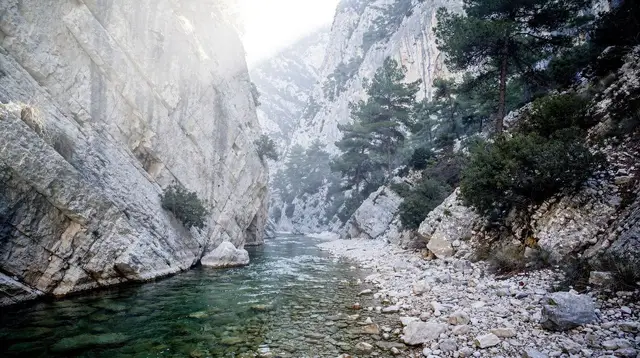
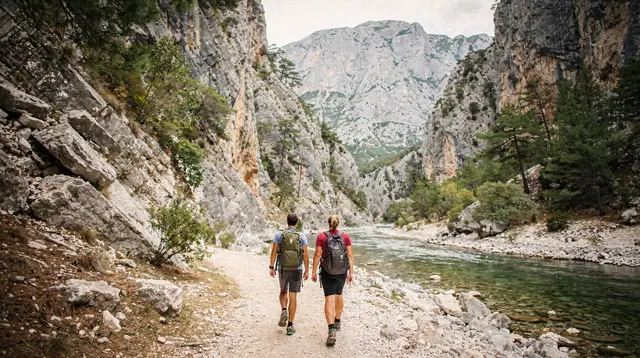
Velika Paklenica (“Great Paklenica”) is the park’s main entrance and its most-visited corner. From the park gate near Starigrad, a broad path runs along the canyon floor, following the course of the Paklenica stream, which is often dry or reduced to a trickle for much of the year. The walls close in as you go, rising into pale limestone cliffs on both sides, and the path itself stays gentle enough for most visitors with ordinary fitness and decent shoes — this is not a technical hike for the first stretch in.
A short way into the canyon, on the right-hand wall, is Anića kuk. It’s one of the best-known climbing walls in this part of Europe, with routes that have drawn climbers to Paklenica since the mid-20th century. Even for visitors with no interest in climbing, it’s worth pausing to look up: the scale of the face against the canyon floor is a large part of what makes Velika Paklenica feel dramatic rather than just scenic.
Deeper into the canyon, the path passes a small watermill and reaches Anića Luka, a widening in the gorge with a mountain hut, before trails begin climbing more steeply toward the Velebit’s upper slopes and further huts beyond. Exactly how far to walk is a personal call — many visitors are satisfied with an hour or two along the flat canyon floor, while more ambitious hikers use Velika Paklenica as the approach route onto longer Velebit routes. We’re not going to invent a distance in kilometres or an elevation figure here, because the honest answer depends on which point in the canyon you turn back from — check the park’s own trail map or your guide for current distances and timing before you set out.
Mala Paklenica: the quieter canyon
Mala Paklenica (“Little Paklenica”) is the park’s second canyon, a short distance north of Velika Paklenica. It’s less developed for visitors and sees a fraction of the footfall — no established path running the full length in the way Velika Paklenica has one, and considerably wilder terrain. For most day-trippers with limited time, Velika Paklenica remains the sensible choice; Mala Paklenica is really for hikers who already know the park, or who are looking for a quieter alternative away from the crowds around Anića kuk.
Anića kuk and climbing in Paklenica
Anića kuk is the reason Paklenica has a reputation well beyond Croatia’s hiking community. The wall rises directly from the canyon floor and carries a network of established multi-pitch routes, drawing climbers from across Europe through the spring and autumn seasons in particular. This is genuine mountain climbing terrain, not a via ferrata or a casual scramble — anyone without their own rope, partner and local route knowledge should look for a licensed climbing guide or school operating in Starigrad or the park itself rather than attempting routes independently.
Even non-climbers get something out of Anića kuk: on a clear day it’s common to spot climbers as small figures partway up the face, a useful reminder of just how big the wall actually is once you’re standing at its base rather than looking at it from a distance.
Getting there from Zadar
Paklenica National Park sits near Starigrad, on the Adriatic coast north of Zadar, reached along the same coastal road that continues up toward Pag and the Velebit foothills. Driving yourself gives the most flexibility, since you can time your visit to avoid the midday heat in summer and decide on the spot how far into the canyon to walk. For visitors without a car, an organised day tour is the simplest route in, though most day tours out of Zadar focus on Krka and Plitvice rather than Paklenica specifically — if hiking Paklenica is your priority, it’s worth checking tour listings carefully for one that includes it, or arranging a private transfer.
If you’re weighing up which inland national park deserves your one big day trip from Zadar, our guide to choosing between Krka and Plitvice is a useful starting point, even though Paklenica itself is a different kind of visit — less about waterfalls, more about trail and rock.
What to bring
Velika Paklenica’s main path is gentle enough that trainers or light hiking shoes are usually fine for a walk along the canyon floor. Anyone heading further — up toward the mountain huts or onto marked Velebit trails — should treat it as a proper hike: sturdy boots, layers, more water than you think you’ll need, and a map or downloaded GPS track, since conditions and waymarking can vary by season. The canyon itself offers patches of shade from the walls and trees, but exposed sections and the approach in summer can get hot, so sun protection and an early start are worth planning around.
As with entrance fees, we won’t state a specific ticket price here, since Croatian national park fees are reviewed periodically — check current prices through the park’s own channels or your chosen tour listing before you go.
Paklenica alongside the rest of North Dalmatia’s outdoors
Paklenica sits within a wider cluster of inland, adventure-focused destinations on the Velebit side of North Dalmatia, distinct from the coastal towns and islands most visitors associate with a Zadar trip. Close by is the Zrmanja river, a limestone canyon river used for kayaking and rafting, and associated with the Winnetou Western films shot in the area decades ago — a very different kind of outdoor day, on water rather than rock, but a natural pairing if you’re building an adventure-themed itinerary. Quad and ATV tours also operate in the hills near Zadar for visitors who’d rather explore this landscape from a vehicle than on foot.
Further inland again are Croatia’s two best-known lake and waterfall parks: Plitvice Lakes National Park, with its sixteen terraced lakes and boardwalk trails, and Krka National Park, reached by boat from the town of Skradin to the Skradinski buk waterfall.
Both are swimming-free zones today (Krka’s ban at Skradinski buk has held since 2021, and Plitvice has never allowed swimming), which sets them apart from Paklenica, where the appeal is walking and climbing rather than water at all. If you’re mapping out which of these three inland parks fits your trip, a guided day tour of either Plitvice or Krka from Zadar is the standard way in, and each can be booked well ahead of a summer visit.
a boat tour of Krka’s waterfalls is one straightforward way to pair a water-based national park day with a rock-and-trail day at Paklenica, without trying to cram both into one exhausting outing.
For the other major inland park, a guided walking tour of Plitvice Lakes covers the terraced lakes and waterfalls on foot with a local guide, while a full day trip to Plitvice from Zadar handles the return transport as well. Travellers who’d rather see Krka’s Skradinski buk waterfall up close with commentary can look at a guided tour of Krka’s Skradinski buk waterfall.
Planning a multi-day North Dalmatia trip around Paklenica
Because Paklenica, Krka and Plitvice each take the better part of a day once driving time is included, most visitors treat them as separate outings rather than combining two parks in one trip. If you have several days based in Zadar, a natural rhythm is one day for the coastal islands, one day for Krka or Plitvice, and a further day for Paklenica or the Zrmanja if outdoor activity is a priority for your trip. Our national parks itinerary and adventure-focused itinerary both give a sense of how to sequence a longer stay without overloading any single day with driving.
For travellers coming in through Zadar Airport, Starigrad and Paklenica are close enough to the coastal road that a rental car makes the whole Velebit side of the region — Paklenica, the Zrmanja, and onward toward Pag and Nin — realistic as day trips without constantly returning to Zadar itself. Our car rental guide covers the practical side of arranging that.
Paklenica National Park Hiking FAQ
Where is Paklenica National Park in relation to Zadar?
Paklenica sits on the seaward slopes of the Velebit mountain range, near the small coastal town of Starigrad, north of Zadar along the Adriatic highway. It’s a manageable day trip by car or organised tour from Zadar’s Old Town.
Do I need to be an experienced hiker to visit Paklenica?
No. Velika Paklenica canyon has a well-maintained gravel path along the riverbed suitable for anyone with reasonable fitness, while routes higher onto the Velebit toward the mountain huts are steeper and better suited to experienced walkers.
Can I climb Anića kuk without a guide?
Anića kuk is a serious multi-pitch limestone wall used by experienced, equipped climbers, not a casual scramble. If you want to try climbing in Paklenica without your own gear and partner, look for a licensed local climbing guide or school rather than attempting routes independently.
Is there an entrance fee for Paklenica National Park?
Paklenica charges a national park entrance fee, as most Croatian national parks do, but exact prices change over time and by season. Check current ticket prices on the park’s own information channels or on your tour listing before you go.
What should I pack for hiking in Paklenica?
Sturdy walking shoes, water, sun protection and a layer for shade inside the canyon are the basics for Velika Paklenica. Anyone heading onto higher Velebit trails or toward the mountain huts should pack as for a proper mountain hike, with more water, warmer layers and a map or offline GPS track.
Can Paklenica be combined with other North Dalmatia parks in one trip?
Yes, though Paklenica, Krka and Plitvice are each their own day out given the driving involved, so most visitors pick one park per day rather than stacking two. A multi-day itinerary based in Zadar can comfortably include Paklenica alongside Krka or Plitvice on separate days.
Is Paklenica connected to the Zrmanja river or the Winnetou films?
Paklenica and the Zrmanja river canyon are both on the inland Velebit side of North Dalmatia and are often paired in a single day of adventure activities, but they are two separate places — Paklenica is hiking and climbing terrain, while the Zrmanja is known for kayaking, rafting and its connection to the Winnetou Western films shot in the area.
What’s the best time of year to hike Paklenica?
Spring and autumn generally offer the most comfortable hiking temperatures, since the canyon can get hot and exposed in the height of summer and some higher trails can hold snow or ice outside the warm season. Check current trail conditions locally before planning anything above the main canyon path in shoulder or winter months.
Outdoor Adventure Tours
Verified deep-linked GetYourGuide tours. Book through these links and we earn a small commission at no cost to you.
GetYourGuide does not provide a product photo for this activity — the image shows the meeting point, photographed by us.