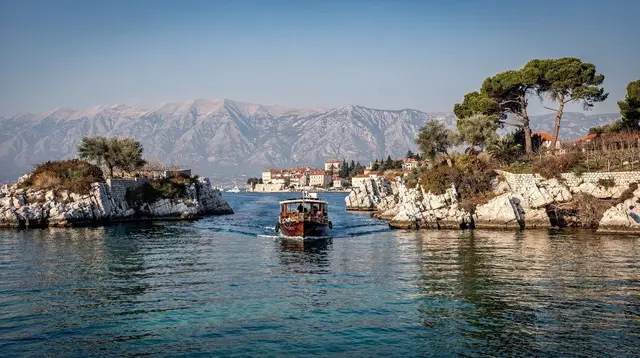
Murter to Kornati: The Boat Tour Guide
Is Murter a good base for visiting Kornati National Park?
Yes. Murter is the closest mainland-connected departure point to Kornati National Park, closer than Zadar, Biograd or Sali, which makes it a popular base for boat tours into the park. It sits within the Šibenik–Krka region of North Dalmatia rather than the Zadar Archipelago.
Why Murter is the classic launch point for Kornati
Ask anyone who has spent time on this stretch of the Adriatic where to catch a boat into Kornati National Park, and Murter comes up almost immediately, alongside Zadar, Biograd na Moru and the island town of Sali on Dugi Otok. Of the four, Murter sits physically closest to the park — it’s the mainland’s last stepping stone before the open water where Kornati’s islands and islets begin. That proximity is the whole reason boat operators cluster here: shorter transit time to the park means more time actually among the islands.
Murter itself is a small island, but it isn’t cut off — a bridge connects it to the mainland near Vodice and Šibenik, so getting there by car or bus from the mainland is straightforward. That bridge connection is also what separates Murter from a true offshore island in the way Ugljan or Dugi Otok are offshore islands in the Zadar Archipelago. Murter belongs to a different part of the map.
In this site’s regional layout, Murter sits within the Šibenik–Krka region of North Dalmatia, grouped with Šibenik town, Krka National Park, Skradin, Vodice and Primošten — not with the Zadar Archipelago cluster of Ugljan, Pašman, Dugi Otok and Kornati that radiates from Zadar city itself. Kornati National Park is reachable from both regions; Murter simply happens to be the closest mainland launch point geographically, regardless of which administrative or touristic region it’s filed under.
It’s an easy point of confusion for first-time visitors piecing together North Dalmatia from a map: Kornati appears near the Zadar Archipelago pages on this site because the park is most often marketed as a Zadar day trip, and plenty of boats do leave from Zadar’s harbour. But nothing about Kornati’s geography ties it exclusively to Zadar. The park is a scattered field of limestone islands and reefs sitting in open water south of the Zadar Archipelago and west of Šibenik, and it takes boats from multiple directions — Murter’s included.
What Kornati National Park actually is
Before getting into the logistics of a Murter departure, it helps to be clear about what you’re sailing toward. Kornati National Park, established in 1980, protects roughly 89 islands, islets and reefs — the wider Kornati archipelago (a looser geographic term than the park boundary) runs to something like 140 features in total. This is not a lush, tree-covered archipelago.
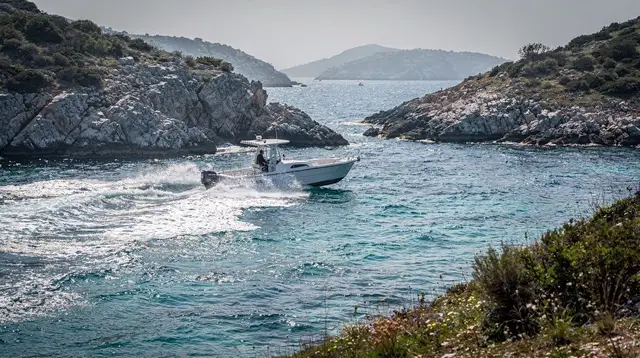
It’s bare, sun-bleached limestone: stark cliffs dropping into intensely clear water, dry scrub where vegetation survives at all, and almost no permanent population beyond a handful of seasonal fishing and farming structures. Photographs of Kornati tend to show this exact contrast — pale stone against deep blue sea — and it’s genuinely one of the more striking landscapes in the Adriatic precisely because of how stripped-back it is.
There are no roads on Kornati, no bridges, and no car ferry service connecting the islands to the mainland. Every visitor arrives by boat, full stop. That’s true whether you’re departing from Zadar, Biograd, Sali or Murter — the park’s isolation is the same regardless of which coastal town you start from, and it’s one of the main reasons Kornati has kept its stripped-down, undeveloped character rather than becoming a resort chain the way parts of the coast further south have.
Boat tour options departing from Murter and nearby Šibenik towns
Because Murter sits so close to Kornati’s northern edge, boat tours from the Šibenik area frequently route through or depart near Murter, even when they’re formally listed as Šibenik tours. A handful of tour formats are worth knowing before you book:
Private boat charters give you a boat and skipper largely to yourselves, with the itinerary shaped around your group rather than a fixed group schedule. For Kornati specifically, this is worth considering if you want more time at a particular cove or the flexibility to skip a stop that doesn’t interest you. One option covering this exact route is a private boat tour into Kornati National Park departing the Šibenik area, which suits smaller groups wanting a more personal pace through the islands.
Full-day group boat tours are the more common way to see Kornati, combining several island stops, a swimming or snorkeling break, and often a look at the park’s more photographed limestone formations within a single day out. A full-day Kornati National Park boat tour from the Šibenik area is built around exactly this format — enough time on the water to get a real sense of the archipelago’s scale rather than a rushed pass-through.
Wildlife-focused trips add a different layer to the standard sightseeing route. Dolphins are sometimes spotted in the waters around Kornati and the wider Šibenik channel, and boats that build in time for slower cruising through likely areas improve the odds of an encounter, though nothing about wildlife spotting can be guaranteed on any given day. A private Kornati boat tour that includes dolphin-watching pairs the park’s landscape with this possibility, run at a private-charter pace rather than a large group schedule.
Snorkeling and wine-focused itineraries take a more relaxed, sensory approach to the same archipelago waters, mixing time in the water with a tasting break rather than treating the day purely as sightseeing. An archipelago boat tour from Šibenik combining snorkeling with wine tasting fits this slower style, useful for travelers who want the scenery without a packed stop-by-stop schedule.
None of these tours list a fixed price or a specific departure time in this guide deliberately — schedules shift seasonally, and operators adjust timing based on daylight, weather and group size. Check the live listing for exact departure windows, current pricing and what’s included before booking.
What a day on the water actually looks like
Whatever specific tour you choose, Kornati boat trips from the Šibenik–Murter side of the coast tend to follow a similar rhythm. Boats leave the harbour and spend a meaningful stretch of open water simply reaching the park boundary, since the islands are spread across a wide area rather than clustered near shore. Once inside the park, the itinerary usually alternates between slow cruising past the limestone cliffs and islets, stops for swimming or snorkeling in a sheltered cove, and sometimes a pause at one of the park’s few inhabited points, where small family-run operations occasionally serve simple meals to passing boats (this varies by tour and isn’t something to assume is included).
Because Kornati has no real settlements to visit and no museums or built attractions in the conventional sense, the appeal of a boat tour here is almost entirely about the landscape itself and the water — the two things this coastline supplies in abundance. If you’re coming from a national park experience built around waterfalls and forest, like Plitvice Lakes or Krka National Park, Kornati will feel like a genuinely different register: dry, stark, and defined by open sea rather than freshwater.
Sea conditions in summer (roughly July–August) bring the warmest water on this stretch of the Adriatic, generally in the 23–26°C range, making swimming stops the most comfortable during peak season. Spring and autumn shoulder months, May–June and September–October, trade a few degrees of water temperature for calmer crowds and often steadier weather for the crossing itself, since Kornati’s open water can turn choppy if the wind picks up.
Murter beyond the boat tours
It’s worth treating Murter as more than a pure transit point. The island has its own quiet character — small coastal villages, olive groves, and views out toward the very islands you’ll later see up close from the water. A guided bike tour around Murter’s bays and heritage sites is a good way to spend a morning or afternoon on the island itself, either before or after a Kornati boat excursion, and gives a sense of what makes this part of the Šibenik–Krka coast distinct from the busier tourist circuits further north around Zadar.
Murter compared with the other Kornati departure points
| Departure town | Region on this site | Typical advantage |
|---|---|---|
| Murter | Šibenik–Krka | Closest mainland point to Kornati; shortest crossing |
| Zadar | Zadar | Most tour choice and frequency; longer transit to Kornati |
| Biograd na Moru | Zadar Archipelago | Coastal town directly opposite the archipelago |
| Sali (Dugi Otok) | Zadar Archipelago | Island-based departure, already partway to Kornati |
This isn’t a ranking of which town is “best” — it depends on where you’re already staying. Travelers based in Šibenik, Vodice or Primošten will naturally find Murter the more convenient departure; those based in Zadar’s Old Town will more likely book through a Zadar-departing tour, even if the crossing itself takes a little longer. For a broader look at how Kornati tours compare across departure points and formats, see this Kornati boat tour guide focused on Zadar departures, or weigh Kornati against its close neighbor with Kornati vs Telašćica: which to visit.
Practical notes for planning a Murter-based Kornati trip
Murter connects to the mainland by bridge, so arriving by car or bus from Šibenik, Vodice or Primošten is straightforward and doesn’t involve a ferry crossing the way reaching truly offshore islands like Dugi Otok or Pašman does. Once on Murter, boat departures for Kornati typically leave from the island’s harbour areas, with exact meeting points specified on each tour’s booking confirmation.
Pack for a full day on open water: sun protection is essential given how little shade Kornati’s bare limestone landscape offers, and a swimsuit and towel are worth having on hand even if a particular tour’s itinerary doesn’t guarantee a swim stop. Because Kornati sits in open water with real distances between islands, sea conditions can affect a day’s exact route — operators sometimes adjust which coves or islets a tour visits based on wind and swell, which is normal and not a sign of a lesser trip.
If you’re building a longer North Dalmatia itinerary around this coast, Murter and Kornati pair naturally with a wider swing through the Šibenik–Krka region — Krka National Park’s waterfalls, Šibenik’s old town and cathedral, and the vineyard terraces around Primošten all sit within relatively easy reach of the same base. For day-by-day planning across the region, the three-day Zadar archipelago islands itinerary and the wider day trips from Zadar hub are useful starting points, even though a Murter-based Kornati day will sit slightly outside a purely Zadar-centered plan.
Frequently asked questions about the Murter to Kornati boat tour
Is Murter part of the Zadar Archipelago?
No. Murter is connected to the mainland by a bridge and sits within North Dalmatia’s Šibenik–Krka region, separate from the Zadar Archipelago islands of Ugljan, Pašman and Dugi Otok, even though it lies close to Kornati National Park.
How do I get from Murter to Kornati National Park?
By boat only. Kornati has no roads, bridges or car ferries connecting it to the mainland, so every visit involves a boat tour or a private charter departing from a coastal town such as Murter, Zadar, Biograd or Sali.
How long does a Kornati boat tour from Murter take?
Most boat tours from Murter to Kornati run as a full or half day out on the water, since the islands are scattered across a wide stretch of sea. Exact durations vary by operator and route, so check the specific tour listing for timing.
Can I swim during a Kornati boat tour?
Yes, most Kornati boat tours include stops for swimming and snorkeling in coves around the islands, though this depends on the specific itinerary and weather conditions on the day.
Is Murter closer to Kornati than Zadar or Sali?
Murter is generally considered the shortest and most direct mainland departure point for Kornati, given its position on the coast nearest the park, though Zadar, Biograd and Sali all run their own boat tours into the archipelago as well.
What else is there to do on Murter besides boat tours?
Murter has a guided bike tour that covers its bays, viewpoints and local heritage, along with quiet coastal villages and views toward the Kornati islands, making it worth a stop even outside a boat excursion.
When is the best time to visit Kornati from Murter?
The summer peak season of July–August brings the warmest sea and busiest boats, while May–June and September–October offer calmer conditions and fewer crowds for a Kornati boat tour from Murter.
Island Hopping Cruises
Verified deep-linked GetYourGuide tours. Book through these links and we earn a small commission at no cost to you.
GetYourGuide does not provide a product photo for this activity — the image shows the meeting point, photographed by us.