Zadar to Zagreb: Is a Day Trip Actually Worth It?
Can you do a day trip from Zadar to Zagreb?
Technically yes, but it's a stretch. Zadar and Zagreb are roughly 285 km apart via the A1 motorway, and the road runs entirely inland, away from the coast. Most travelers find it works far better as a one-way transfer between two bases, or as a multi-day stop, than as an out-and-back day excursion.
Zadar and Zagreb both sit inside the same country, both appear on the same Croatia itinerary lists, and both are reachable by the same A1 motorway. It’s tempting to assume that makes them easy to combine on a single day out. They don’t, not really — and understanding why is more useful than a rushed attempt to prove otherwise.
The distance, and why it changes the math
Zadar and Zagreb are separated by roughly 285 km of road, almost entirely via the A1 motorway. For comparison, Zadar and Split sit about 160 km apart — already a meaningful drive, and one most people treat as a half-day commitment each way. Zagreb is nearly double that distance. A same-day return trip means covering close to 570 km of driving alone, before accounting for any time actually spent in the city.
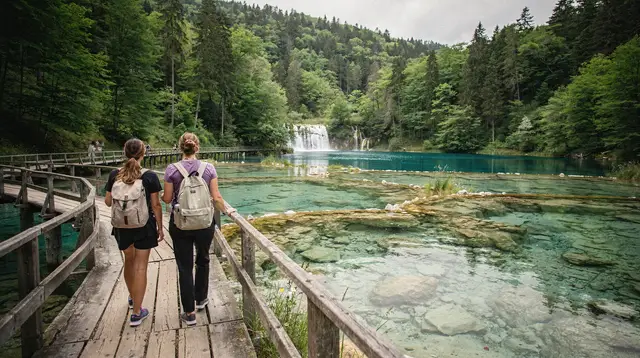
That single fact reshapes almost everything else about how to plan this route. A day trip to Plitvice Lakes National Park or Krka National Park from Zadar works because the destination is under 130 km away and the point of the day is the destination itself — walking trails, waterfalls, a few hours outdoors. Zagreb is a capital city with museums, a historic upper and lower town, restaurants, and neighborhoods that reward slow exploration. Arriving exhausted from a long drive and leaving a few hours later to make the return trip undersells both the city and the effort of getting there.
It’s an inland route, not a coastal one
This is the detail most first-time visitors get wrong. The coastal roads that link Zadar to Split, or Zadar to Šibenik, run along or near the Adriatic, with sea views for long stretches and the option to stop at small coastal towns along the way. The road to Zagreb does the opposite. It heads inland almost immediately, climbing up through the Velebit foothills and the Lika plateau before dropping down toward the Croatian interior and, eventually, Zagreb itself.
This matters for two reasons. First, don’t expect a scenic coastal drive — the Adriatic disappears from view early on and doesn’t return until you’re back near Zadar. Second, the route passes through genuinely different terrain: karst plateaus, forested hills, and the kind of inland Croatia that most coastal-based travelers never see, since Zadar, Nin, Pag, and the archipelago islands all sit on or near the coast. If mountain and inland scenery interests you, that’s a genuine upside of this route rather than a downside — it’s simply not the Adriatic you came for.
Why we won’t give you a drive time
It’s fair to want a number — “how many hours does it actually take?” is the natural next question. We’re deliberately not answering it here with a fixed figure. Drive time on this route depends on traffic (particularly around Zadar and Zagreb’s own city limits), roadworks, weather in the Lika highlands during winter, and whether you’re driving straight through or stopping.
A number that’s accurate today can be wrong within a season. The same goes for bus and train fares and exact timetables: schedules and pricing on Croatian long-distance routes change, and repeating an outdated figure here would do you a disservice. Check a live route planner, a current bus operator’s timetable, or a train booking site close to your travel date for numbers you can actually rely on.
What we can say with confidence: this is a long journey by any measure, whether you drive it yourself, take a bus, or use a private transfer. Budget the better part of a day for travel alone if you’re doing it as a round trip.
How people actually get between Zadar and Zagreb
By car. The A1 motorway is the standard route and the most flexible option, letting you stop along the way in Lika or near Plitvice. Renting a car in Zadar is straightforward — see our car rental guide for what to expect — though tolls apply on the A1 and should be factored into your trip cost.
By bus. Long-distance buses connect Zadar and Zagreb multiple times daily, and this is the most common option for travelers without a rental car. Buses generally follow the A1 corridor as well. Book through a current timetable rather than assuming a fixed departure time or price.
By train. Rail options between Zadar and Zagreb exist but are more limited than the bus network on this particular route, and journey times can run longer than the equivalent bus. If train travel matters to you, check current timetables before building a schedule around it.
Private transfer or organized tour. Some travelers prefer a private transfer, especially if arriving with luggage directly from Zadar Airport or connecting onward. This removes the logistics question entirely but costs more than a public bus.
Why this works better as a one-way trip than a round trip
The single biggest adjustment we’d suggest: stop thinking of Zadar–Zagreb as a “day trip” in the way you’d think about Plitvice Lakes or Krka, and start thinking of it as a transfer between two bases.
If your itinerary already includes both the coast and the capital — a common pattern for a longer Croatia trip — routing it as Zadar first, then a one-way trip up to Zagreb (or the reverse), with at least one night in each place, uses the same road distance far more productively than a same-day round trip would. You arrive in Zagreb with energy left to actually see it: Ban Jelačić Square, the Upper Town, the cathedral, the museums that make the city worth the detour in the first place. A round-trip day squeezes all of that into a few compressed hours sandwiched between two long drives.
For travelers who genuinely only have a single spare day and no interest in relocating their base, we’d steer you toward a shorter, closer excursion instead — Plitvice Lakes, Krka National Park, or the Zadar archipelago all deliver a fuller day for a fraction of the travel time.
What’s actually along the way
Because the A1 route to Zagreb runs through Lika, it passes reasonably close to a few stops worth knowing about, even if you’re not planning to linger.
Plitvice Lakes National Park sits within a manageable detour of the main route north from Zadar, which is exactly why so many travelers try to combine “Zagreb” and “Plitvice” into one trip — and why we’d gently discourage attempting both destinations properly in a single day. Treat them as two separate outings, or as two stops on a multi-day north-bound itinerary, rather than one long push.
The Lika region and inland karst landscape. This stretch of Croatia doesn’t get the attention the coast does, but it includes the Velebit mountain range, small inland towns, and a noticeably different climate and terrain than anything you’ll see in Zadar or on the islands. If you’re driving rather than taking a bus, this is genuinely worth glancing at rather than treating as dead time between two destinations.
A guided day trip that includes a stop in this inland corridor can be a good way to see part of this landscape without committing to the full Zagreb transfer — for travelers curious about inland Lika without the capital city itself, the Tesla Memorial Center and Grabovača Cave day trip from Zadar covers a slice of this inland terrain, including a cave system and the birthplace museum of Nikola Tesla, without requiring a full push all the way to Zagreb.
Alternatives if the distance gives you pause
If, having read all of this, Zagreb sounds like more commitment than your Zadar-based trip has room for, you have good alternatives that deliver a full, satisfying day without the long inland haul.
A full-day national park tour from Zadar gets you into one of the region’s signature landscapes and back to your hotel the same evening, with none of the round-trip fatigue that a Zagreb attempt involves. For Plitvice Lakes specifically, a guided tour of Plitvice Lakes handles the transport and timed-entry logistics for you — useful given the park’s advance-ticket system and its strict no-swimming rule throughout the lakes.
Travelers who want a slower, more local-feeling stop in the Lika interior, rather than the full Zagreb push, might also consider the ceramic workshop near Plitvice Lakes at Janja Gora, a small hands-on stop that pairs naturally with a Plitvice day and gives a genuine taste of inland Croatian craft traditions without adding hours of extra driving.
Planning a longer Croatia itinerary that includes Zagreb
If Zagreb is a firm part of your trip — reasonable, since it’s Croatia’s capital and a genuinely different kind of city experience than anything on the coast — the better question isn’t “can I day-trip it from Zadar” but “how do I sequence it.” A few patterns work well:
| Approach | How it works | Best for |
|---|---|---|
| One-way transfer | Spend your coastal days in Zadar, then travel north to Zagreb for 1–2 nights before flying home or continuing your trip | Travelers who want both the coast and the capital without backtracking |
| Zagreb first, then coast | Start in Zagreb, then head south to Zadar and the islands | Travelers arriving via Zagreb’s international airport |
| Skip Zagreb this trip | Focus fully on Zadar, North Dalmatia, and day trips within a couple of hours | Shorter trips, or a first visit focused on the coast |
| Add Plitvice as the midpoint | Break the Zadar–Zagreb transfer with a stop at Plitvice Lakes along the way | Travelers who want both Zagreb and Plitvice without cramming either |
None of these requires the same-day round trip that makes this route feel harder than it should. For a broader sense of how many days a Zadar-based trip typically needs before adding a capital-city extension, our guide on how many days to spend in Zadar is a useful starting point, and our roundup of the best day trips from Zadar covers the options that do work well as genuine single-day outings.
Frequently asked questions about Zadar to Zagreb
How far is Zagreb from Zadar?
About 285 km by road, mostly via the A1 motorway. That is roughly double the distance from Zadar to Split, which sits about 160 km away.
Is Zadar to Zagreb a coastal drive?
No. Unlike the Zadar–Split road, which hugs the Adriatic for stretches, the A1 to Zagreb cuts inland through the Lika region and the Dinaric mountains, away from the sea for most of the journey.
How long does it take to get from Zadar to Zagreb?
This depends on traffic, the exact route, and your mode of transport, so we won’t state a fixed number of hours here. Check a live bus, train, or driving route planner for a current estimate before you book.
Should I do Zadar to Zagreb as a day trip or an overnight stay?
Most travelers are better served treating it as a one-way transfer, ideally with a night in Zagreb, rather than a there-and-back day trip. The distance and inland routing make a same-day round trip long and tiring for relatively little time in the capital.
Does the route to Zagreb pass close to Plitvice Lakes?
Yes, roughly. The A1 corridor through Lika runs within reasonable reach of Plitvice Lakes National Park, which is why many travelers combine a stop there with the Zadar–Zagreb journey rather than attempting Zagreb and Plitvice on the same day.
Is there a direct bus or train from Zadar to Zagreb?
Bus services run on this route. For exact timetables and fares, check a live bus operator’s booking site rather than relying on a fixed number here, since schedules and prices change.
What’s a better use of a single free day from Zadar: Zagreb or Plitvice Lakes?
For most travelers based in Zadar with one spare day, Plitvice Lakes National Park is the more realistic and rewarding choice. Zagreb is a genuinely different kind of destination — a capital city, not a national park — and deserves its own dedicated visit rather than being squeezed into a single long day.
Day Trips from Zadar
Verified deep-linked GetYourGuide tours. Book through these links and we earn a small commission at no cost to you.
GetYourGuide does not provide a product photo for this activity — the image shows the meeting point, photographed by us.