Krka National Park: What to Know Before You Go
What do I need to know before visiting Krka National Park?
Krka National Park is roughly 85-90 km from Zadar, about 90 minutes to two hours by road. Most visitors reach the main waterfall, Skradinski buk, by boat from the riverside town of Skradin. Swimming has been banned there since 2021, so plan the visit as a walking and boat trip rather than a swim day.
Getting your bearings before you go
Krka National Park sits roughly 85-90 km south of Zadar, which usually works out to somewhere between an hour and a half and two hours on the road, depending on your route and traffic through the coastal towns along the way. That makes it a comfortable day trip, whether you’re driving yourself, joining an organized tour, or arriving via public transport with a connection through Šibenik.
The park is built around the Krka river, and its identity is really a river identity rather than a lake identity — worth keeping in mind if you’re coming straight from Plitvice or planning to visit both. Where Plitvice is a network of lakes connected by wooden walkways, Krka is a river corridor punctuated by waterfalls, with boats doing a lot of the work that walking paths do elsewhere. If you’re trying to decide between the two, our separate comparison on Krka vs Plitvice goes through the differences in more depth.
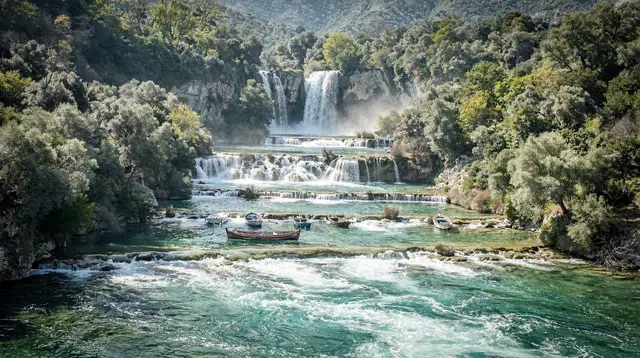
The most visited part of the park by a wide margin is Skradinski buk, a series of cascading travertine barriers and pools that has become one of the defining images of Croatian nature tourism. But the park is larger than that one waterfall, and knowing the layout — Skradin, Skradinski buk, Visovac, and Roški slap — will help you decide how much time to set aside and what to prioritize.
The gateway town: Skradin
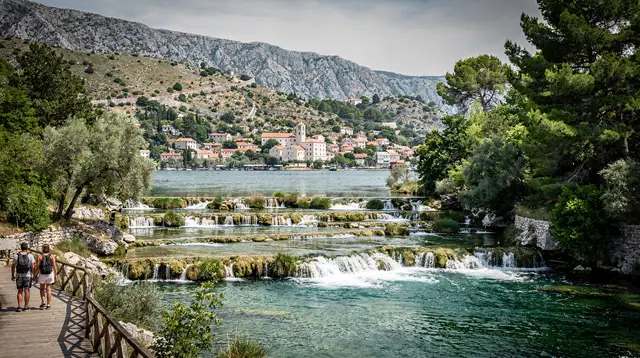
Most visits to Krka’s main waterfall area start in Skradin, a small stone town on the Krka river that serves as the park’s principal entry point on this side. Skradin itself is worth a slow look before you board a boat — it’s a compact, quiet place with a harbor, a hillside of stone houses, and a pace that feels a world away from the crowds gathering for the waterfall a short ride upstream.
From Skradin, park boats carry visitors up the river to Skradinski buk. This boat leg is included as part of the standard park visit in this direction, and it’s as much a part of the experience as the waterfall itself — the river narrows and widens, reed beds line the banks in places, and the first glimpse of the travertine barriers ahead builds a sense of arrival that you don’t get if you approach on foot from elsewhere. If you’d rather have this whole leg — Skradin, the boat ride, and the waterfall — organized for you with a guide explaining what you’re looking at, a guided boat tour from Skradin takes care of the logistics.
For visitors basing themselves further away, in Zadar itself, a full day trip that bundles transport, the boat leg and time at the falls removes the need to arrange each piece separately — see the day trip to Krka from Zadar for that option.
Skradinski buk — and the swimming rule you need to know
Skradinski buk is the park’s headline attraction: a cascade of travertine barriers where the river tumbles down a series of pools over roughly 800 metres, with wooden walkways threading along and across the water so you can walk right through the middle of it. It’s genuinely dramatic, and photographs of it are probably what brought Krka onto your radar in the first place.
Here is the detail that trips up a surprising number of visitors, so it’s worth stating plainly and repeating: swimming at Skradinski buk has been prohibited since 2021. This is not a seasonal closure, not a rule that only applies during busy periods, and not something enforced loosely. It is a standing park regulation, introduced to protect the travertine formations and the wider ecosystem from the damage that decades of swimming had caused. If you’ve seen older photos, videos or blog posts showing people swimming in the pools at Skradinski buk, those depict a version of Krka that no longer exists — treat any source suggesting otherwise as out of date.
This matters for how you plan the day. Pack for walking and photography, not for a swim stop. Bring good shoes for the wooden walkways, sun protection, and water to drink, but leave the idea of cooling off in the pools out of the plan entirely. Rangers and staff are present in the area, and the rule is actively maintained, so this isn’t a case of an official sign being widely ignored.
If a swim in fresh water is part of what you were hoping for on this trip, that’s simply not what a Skradinski buk visit offers any more — it’s now firmly a walking and viewing experience. For background on how and why the rule came about, our companion piece on Krka after the swimming ban goes into more detail.
A guided visit can help make sense of what you’re looking at beyond the photo opportunity — the geology of how travertine forms, the mills that once operated along this stretch of river, and the layout of the walkways so you don’t miss a viewpoint. The guided tour of Skradinski buk waterfall covers this ground with a local guide.
Visovac: the island monastery
A short boat ride from the Skradinski buk area brings many visitors to Visovac, a small island in the middle of the Krka river holding a Franciscan monastery and church. It’s a quieter, more contemplative stop than the waterfall crowds, and its setting — a single island with a cluster of stone buildings surrounded entirely by river — is distinctive enough that it’s worth including if your itinerary allows.
Visovac is reachable only by boat, and a number of the boat tours operating out of Skradin build in a stop here as part of the same trip, rather than requiring a separate booking. If island time and a slower pace appeal to you alongside the waterfall visit, look for a tour itinerary that explicitly lists Visovac as a stop rather than assuming every Skradinski buk boat includes it.
Roški slap: the quieter waterfall
Further upstream from Skradinski buk lies Roški slap, another waterfall area within the park, generally with noticeably fewer visitors than the main site. Where Skradinski buk has become something of a set-piece attraction, Roški slap tends to feel more like a natural river landscape you’re passing through, with its own cascades and mill remains along the banks.
Roški slap is usually treated as a separate stop from Skradinski buk rather than something you reach on the same short boat hop — check whether your chosen tour or ticket includes both areas, since not all of them do. A dedicated entry ticket for Roški slap is a straightforward way to add this quieter part of the park to your visit, and travelers who want to see the whole park rather than choosing between sites sometimes prefer an all-sites entry ticket covering the full park.
Planning your Krka day: the practical shape of a visit
A typical Krka day built around Skradinski buk runs roughly like this: arrival in Skradin, a boat transfer up the river, time walking the wooden paths through the waterfall area, and a boat back down — with Visovac added in either direction if your itinerary includes it. Visitors who also want Roški slap generally treat it as an extension requiring more time, given its distance from the main site.
We won’t state specific ticket prices, exact opening hours or fixed tour durations here, because these details shift by season and by year, and a number printed in an article can quietly go stale. For the current entrance fee, opening times and what’s included at each site, check the official park information or a live tour and ticket listing — the Krka day trip from Zadar and the tickets above will show current availability and pricing when you’re ready to book.
| Site | What it is | Typical access |
|---|---|---|
| Skradin | Riverside gateway town | Base for boats to Skradinski buk |
| Skradinski buk | Main waterfall, travertine barriers | Boat from Skradin, then walkways |
| Visovac | Island monastery | Boat only, often combined with Skradinski buk |
| Roški slap | Quieter upstream waterfall | Separate stop, sometimes a longer trip |
Getting there: your options from Zadar
If you’re basing yourself in Zadar, there are a few realistic ways to reach Krka. Self-driving gives you the most flexibility — you can decide on the day how much time to spend at Skradinski buk versus pushing on to Roški slap, and you’re not tied to a group’s schedule. The route runs south along the coastal road, usually with a pass near or through Šibenik territory before turning inland to Skradin.
If you’d rather not deal with parking, navigation or driving after a full day of walking, an organized day trip to Krka from Zadar handles the transport in both directions and typically includes the boat leg from Skradin. This is the option most first-time visitors choose, since it removes the logistics entirely and leaves you free to focus on the waterfalls rather than the road.
A private option exists too, for travelers who want a driver and guide on a schedule built around them rather than a fixed group departure time — useful if you’re combining Krka with another stop the same day, or traveling with people who need a slower pace on the walkways. Public transport is possible but less direct, generally involving a bus connection through Šibenik, and it’s worth weighing the time saved against the flexibility lost before choosing that route over a tour or a rental car.
Whichever way you arrive, aim to start relatively early in the day. Skradinski buk draws large numbers of visitors, especially in the warmer months, and the walkways can feel considerably more crowded by midday than they do first thing in the morning. An early start also gives you more room to add Roški slap or a stop in Šibenik afterward without rushing.
What to pack and how to plan your time
Because swimming is off the table, think of a Krka visit the way you’d think of a walking tour with a boat ride attached, not a beach day. Comfortable, closed shoes matter more here than they might elsewhere — the wooden walkways at Skradinski buk can be uneven and, in wetter conditions or after rain, slightly slick near the water. Sandals or flip-flops are a poor choice for a full circuit of the falls.
Sun protection is worth taking seriously too. Much of the walkway network at Skradinski buk has little shade, and a summer visit under a midday sun can be more draining than the relatively short distances involved would suggest. A hat, sunscreen and a refillable water bottle cover the basics; a light rain layer is sensible outside the height of summer, since river valleys like this one can see quick weather changes.
On timing, give Skradinski buk itself a few hours at minimum to walk the full walkway loop without feeling rushed, and build in extra time if Visovac is part of your route, since the island visit adds a separate boat leg. Visitors adding Roški slap should treat it as a genuinely separate excursion within the park rather than a quick add-on, given the distance from the main site — decide before you set out whether you’re doing a focused Skradinski buk visit or a longer day covering more of the park.
Combining Krka with the rest of the region
Because Krka sits close to Šibenik, plenty of day trips from Zadar pair the two: a morning at the waterfalls followed by an afternoon walking Šibenik’s old stone streets and its UNESCO-listed cathedral. If that appeals more than a Krka-only day, our guide to Šibenik as a day trip from Zadar lays out how the pairing works, and the wider roundup of best day trips from Zadar puts Krka in context against the other options — Plitvice, the islands, Nin and Pag among them.
If you’re weighing Krka against Plitvice Lakes and aren’t sure which suits your trip better, our dedicated comparison, Krka vs Plitvice: which to choose, walks through the practical differences — travel time from Zadar, the walking versus boat experience, and what each park bans and allows. And if Plitvice is also on your list, it’s worth knowing before you go that swimming isn’t allowed there either, for reasons that mirror Krka’s own rule.
Krka National Park: frequently asked questions
How far is Krka National Park from Zadar?
Roughly 85-90 km, which usually works out to about 90 minutes to two hours by road depending on the route and traffic. It’s a realistic day trip from Zadar, either self-driven or on an organized tour.
Can you swim at Skradinski buk?
No. Swimming at Skradinski buk has been prohibited since 2021. This is a standing rule, not a seasonal restriction, and it applies regardless of the weather or how many other visitors you see near the water.
How do you get to Skradinski buk?
Most visitors reach Skradinski buk by park boat from the town of Skradin, which sits at the park’s entrance. Boats run between Skradin and the waterfall area as part of the standard visitor route.
What is Visovac and can you visit it?
Visovac is a small island in the Krka river with a Franciscan monastery and church, reachable only by boat. Many boat tours from Skradin include a stop at Visovac along the way to or from the waterfalls.
What is Roški slap?
Roški slap is another waterfall area within Krka National Park, generally quieter than Skradinski buk. It sits further upstream and is often visited as a separate stop from the main Skradinski buk area.
Do I need to book Krka tickets in advance?
For exact ticket prices, opening hours and booking windows, check the official park listing or a current tour or ticket page rather than relying on a fixed figure, since these details change by season.
Is Krka better than Plitvice Lakes?
They’re different experiences: Krka centers on boat access and a single dramatic waterfall area, while Plitvice is a walking circuit through a chain of lakes. Many visitors do both on separate days, since each has its own character.
Can you combine Krka with Šibenik in one day?
Yes, Krka National Park and the historic town of Šibenik sit close together, and a number of day trips from Zadar pair a Krka waterfall visit with a walk through Šibenik’s old town.
Krka Waterfalls Tours
Verified deep-linked GetYourGuide tours. Book through these links and we earn a small commission at no cost to you.
GetYourGuide does not provide a product photo for this activity — the image shows the meeting point, photographed by us.