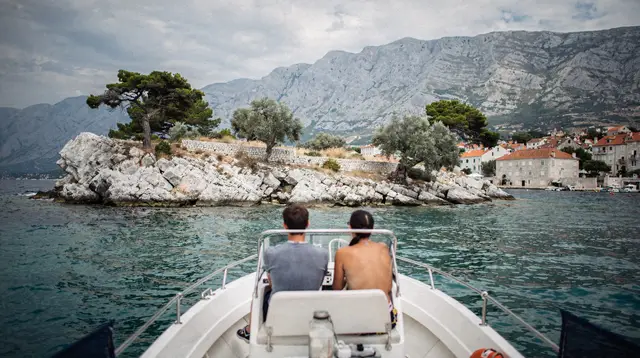
Ugljan and Pašman Island Hopping from Zadar
Can you visit Ugljan and Pašman as a day trip from Zadar?
Yes. Small passenger boats and vehicle ferries leave the Old Town harbour area for Preko on Ugljan in a short crossing, and Ugljan connects on to Pašman by a bridge at Ždrelac, so both islands are reachable in a single day. These are short local links, separate from the Jadrolinija long-haul ferries that sail from Gaženica port.
Ugljan and Pašman sit so close to Zadar that they barely register as a “trip” at all — more like a short crossing of the channel that separates the Old Town from a different, slower rhythm of island life. Together with Ugljan’s tiny neighbour Ošljak, they make one of the easiest island-hopping days in the whole Zadar Archipelago, and one that does not require booking a full-day speedboat charter or an early alarm for a Kornati run.
Why Ugljan and Pašman work as a pair
Ugljan and Pašman are joined by a bridge at Ždrelac, so once you have crossed the water from Zadar, moving between the two islands is a matter of driving, cycling or being driven, not a second boat booking. That single fact is what makes this pairing efficient: one crossing from the mainland, then a loop that takes in two islands with genuinely different characters.
Ugljan is the greener, more populated of the two, its slopes terraced with olive groves that in places are said to be centuries old. Its main village, Preko, faces Zadar directly across the channel and has the look of a place that has always lived in dialogue with the city rather than apart from it. Pašman, by contrast, feels more withdrawn — smaller villages, quieter coves, and a coastline that rewards slow exploration rather than a checklist of sights.
Neither island tries to compete with the headline attractions of the wider region — nobody comes here expecting the scale of Plitvice Lakes or the bare drama of Kornati. What Ugljan and Pašman offer instead is proximity and ease: a real island atmosphere reachable within a single morning, which makes them a natural half-day or full-day addition to a longer Zadar itinerary.
Getting across: the short crossing, not the long ferry
This is the point where visitors most often get confused, so it is worth being precise about it. Zadar has two separate ferry systems, and they should not be mixed up.
The long-distance Jadrolinija ferries — the ones that connect Zadar to Ancona in Italy, or run the coastal line down to Split and beyond — sail from Gaženica port, a purpose-built terminal south of the city centre. Those are not the boats you want for Ugljan.
For Preko, the crossing point on Ugljan, small passenger boats and vehicle ferries instead depart from the harbour area right by the Old Town itself — a short walk from the Sea Organ and Riva, not a taxi ride to an industrial port. This guide will not state a specific crossing duration, sailing frequency or ticket price, because these details change by season and operator: check the current Zadar–Preko timetable and fare before you travel, ideally the same day if your plans are flexible.
Once on Ugljan, reaching Pašman is straightforward by road via the Ždrelac bridge — no second boat needed. If you would rather skip the logistics of ferry timetables and hire cars altogether, a guided boat tour from Zadar handles the whole loop for you, often building in a swim stop, a village visit, and sometimes Ošljak, all timed and organised in one outing.
Ugljan: olive groves and the village of Preko
Preko is Ugljan’s largest village and the natural first stop after the crossing. It has a small harbour, a scatter of cafés along the waterfront, and views straight back across the channel to Zadar’s peninsula — a reversal of the usual sightline that is worth pausing for. Away from the harbour, the island’s interior is given over to olive groves, many of them old and gnarled, climbing gently up the slopes that face the mainland.
There is a ruined Venetian-era fort, Sveti Mihovil, on high ground above the island, though this guide will not give hours or a route grade for the climb — treat any hiking plan as a matter of checking current local signage and conditions rather than fixed instructions here. The appeal of Ugljan is less about ticking off a single landmark and more about the texture of the place: narrow lanes between stone walls, small stony coves for swimming, and a pace that noticeably slows down within a few hundred metres of the ferry dock.
Ošljak: the islet just offshore
A short distance off Preko sits Ošljak, a tiny islet that is reportedly one of the smallest permanently inhabited islands in the Adriatic. It has no cars, a single small settlement, and a walking loop that covers the whole islet in well under an hour. Ošljak rarely appears on its own in trip planning — it works best as an add-on, either reached by a small local boat from Preko or folded into a guided tour that already covers Ugljan’s coastline.
Several boat tours from Zadar specifically combine Ugljan and Ošljak, treating the islet as a scenic detour rather than a full stop in its own right — worth knowing if your time is limited and you would rather see three small places well than rush through a longer list. For a tour built around exactly this pairing, a half-day boat tour taking in both Ugljan and Ošljak covers the ground without requiring you to piece together separate crossings yourself.
Pašman: quieter coves and small villages
Crossing the Ždrelac bridge onto Pašman changes the mood noticeably. Where Ugljan feels connected and lived-in, Pašman feels more set apart — its villages smaller, its coastline less developed, its coves easier to have largely to yourself outside the height of summer. The island does not offer a single must-see landmark so much as a string of quiet bays suited to swimming and slow driving between villages.
Because Pašman receives fewer day visitors than Ugljan, it rewards travellers who are content to explore without a fixed itinerary — stopping wherever a cove looks inviting, rather than working through a checklist. For those who would rather see it by boat rather than by road, a boat tour to Pašman that also calls at nearby Turanj gives a look at this quieter island alongside a short stretch of the mainland coast, with wine included on some sailings.
Kali and Kukljica: fishing villages worth a detour
Beyond Preko, Ugljan holds a string of smaller settlements that rarely make it into a rushed itinerary but reward a slower loop of the island. Kali, a little further south along the coast road, has long made its living from fishing rather than tourism, and it still shows — nets drying by the harbour, working boats outnumbering pleasure craft, and a waterfront that feels closer to a working port than a resort. Near the southern tip of Ugljan, Kukljica faces across the channel toward Pašman and has a sandy stretch of coast that stands out on an island otherwise defined by rock and pebble, making it a natural stop for anyone travelling with children or simply after an easier swim than the coves further north.
These villages are easiest to reach with your own transport, since they sit some distance from Preko and are not typically included on shorter guided boat tours. For travellers with a rental car who want to see more of the island than the harbour village alone, a loop taking in Kali and Kukljica adds an hour or two of driving and a genuinely different feel from Preko’s café-lined waterfront — closer to the quieter mood of Pašman than to Ugljan’s busier north.
Best time of year for this trip
Like most of the Zadar Archipelago, Ugljan and Pašman are at their easiest in late spring and early autumn, when the crossing and the roads are quieter and the coves are not at their busiest. In the height of summer, the short passenger crossing to Preko can fill up on the more popular sailings, and parking around the harbour gets tight — reasons to travel early in the day if you are going independently rather than on an organised tour, where the operator handles the logistics for you.
Outside summer, both islands are noticeably slower, which suits the mood of Pašman especially well, though some smaller seasonal cafés and konobas may not be open — worth checking ahead if you are planning around a specific stop.
Practical notes for the day
A few points worth keeping in mind whatever way you choose to visit. First, the two ferry systems really are separate: the short Zadar–Preko crossing and the long-distance Jadrolinija sailings from Gaženica share nothing but the name “ferry,” and mixing them up in your planning is the single most common mistake visitors make.
Second, if you are driving, remember that vehicle space on the passenger crossings can be limited, especially in summer — a guided boat tour or a walk-on crossing followed by bike or foot exploration around Preko sidesteps this entirely. Third, pack for a swim: even a half-day loop of Ugljan and Ošljak usually passes at least one inviting cove, and many of the guided boat tours build in time to stop and swim rather than rushing straight between villages.
Anyone travelling without a car should not assume Kali or Kukljica are easy add-ons to a Preko-based day — they are a further drive or cycle from the ferry dock, so a boat tour or a Preko-focused walk remains the more realistic plan for a single day without your own transport.
Boat tours that cover the loop for you
If timetables and hire cars are more friction than you want on a single day, the simplest approach is a guided boat tour that handles the whole Ugljan–Pašman–Ošljak loop in one outing, usually with a swim stop or two built in. This also sidesteps any confusion between the short Preko crossing and the long-haul Gaženica ferries, since the tour boat departs directly from Zadar and handles the route itself.
A few options worth knowing about:
- A boat trip from Zadar to Ugljan’s Frnazagalevac cove and Ošljak, with a stop for local anchovies and beer pairs the coastline with a taste of the island’s food traditions.
- For a more active half day, a half-day island escape combining a boat transfer with bike and stand-up paddleboard time suits travellers who want to move rather than just sightsee.
- Further along the coast, a dolphin-watching tour departing from nearby Biograd na Moru is worth considering as an add-on for a second day in the archipelago, since Biograd na Moru sits directly opposite this cluster of islands on the mainland coast.
Planning your day
| Stop | What it offers | How to reach it |
|---|---|---|
| Preko, Ugljan | Harbour village, olive groves, views back to Zadar | Passenger boat or vehicle ferry from Zadar Old Town harbour |
| Ošljak islet | Tiny inhabited islet, short walking loop | Small local boat from Preko, or a guided tour that includes it |
| Pašman | Quiet coves, small villages | By road across the Ždrelac bridge from Ugljan |
| Turanj (mainland) | Short coastal stop, sometimes paired with Pašman tours | Included on some Zadar–Pašman boat tours |
A single day is enough to get a real sense of Ugljan and a taste of Pašman, especially if you are travelling by guided boat rather than juggling ferry schedules and a rental car. Travellers with more time, or basing themselves in the Zadar Archipelago for a few days, might pair this with a longer stay exploring Dugi Otok or a boat day out to Kornati National Park, both reachable from the same stretch of coast.
Where this fits with the rest of the archipelago
Ugljan and Pašman are the closest islands to Zadar, which makes them the natural starting point for anyone building up to the more remote parts of the archipelago — Telašćica Nature Park on Dugi Otok, or the bare limestone islets of Kornati further out. Compared to those, Ugljan and Pašman are gentler, greener, and far easier to reach without advance planning, which is exactly why they suit a first or a last day in the region rather than the centrepiece of a week-long trip.
If your schedule allows for a second island day, consider following this trip with something further out — a Kornati and Telašćica combo tour shows a very different, starker side of the same archipelago, while a Dugi Otok Sakarun beach day trip trades olive groves for one of the region’s best-known sandy bays. Either makes a natural next step once Ugljan, Pašman and Ošljak are behind you.
Frequently asked questions about visiting Ugljan and Pašman
How do you get from Zadar to Ugljan?
Small passenger boats and car ferries cross from the Old Town harbour area to Preko, Ugljan’s main village. This is a short local crossing, not one of the long-distance Jadrolinija sailings that depart from Gaženica port south of the centre.
Are Ugljan and Pašman connected to each other?
Yes, a bridge at Ždrelac links the two islands, so it is possible to drive or cycle between them without a second boat crossing.
What is Ošljak?
Ošljak is a tiny inhabited islet just off Preko, reportedly one of the smallest permanently inhabited islands in the Adriatic. It makes an easy add-on stop on a boat tour of the area.
Do you need a car to explore Ugljan and Pašman?
A car or scooter helps for reaching villages and coves spread along both islands, but a guided boat tour or the passenger ferry to Preko works well for a shorter visit focused on Ugljan’s town and coastline.
What is Ugljan known for?
Ugljan is known for its olive groves, some centuries old, and for the relaxed village of Preko, which faces Zadar’s Old Town across the channel.
Is Pašman worth visiting on the same day as Ugljan?
Pašman is quieter and less visited than Ugljan, with sheltered coves and small villages, so pairing the two in one day gives a contrast between Ugljan’s olive-grove landscape and Pašman’s calmer coastline.
How long does the crossing to Preko take?
This guide does not state a crossing time or fare, since these can change by season and operator — check the current timetable and ticket price for the Zadar–Preko line before you travel.
Can you swim around Ugljan and Pašman?
Yes, both islands have rocky and pebble coves suited to swimming, and several boat tours from Zadar build in stops for swimming and snorkelling around this stretch of coastline.
Boat Tours
Verified deep-linked GetYourGuide tours. Book through these links and we earn a small commission at no cost to you.
GetYourGuide does not provide a product photo for this activity — the image shows the meeting point, photographed by us.